
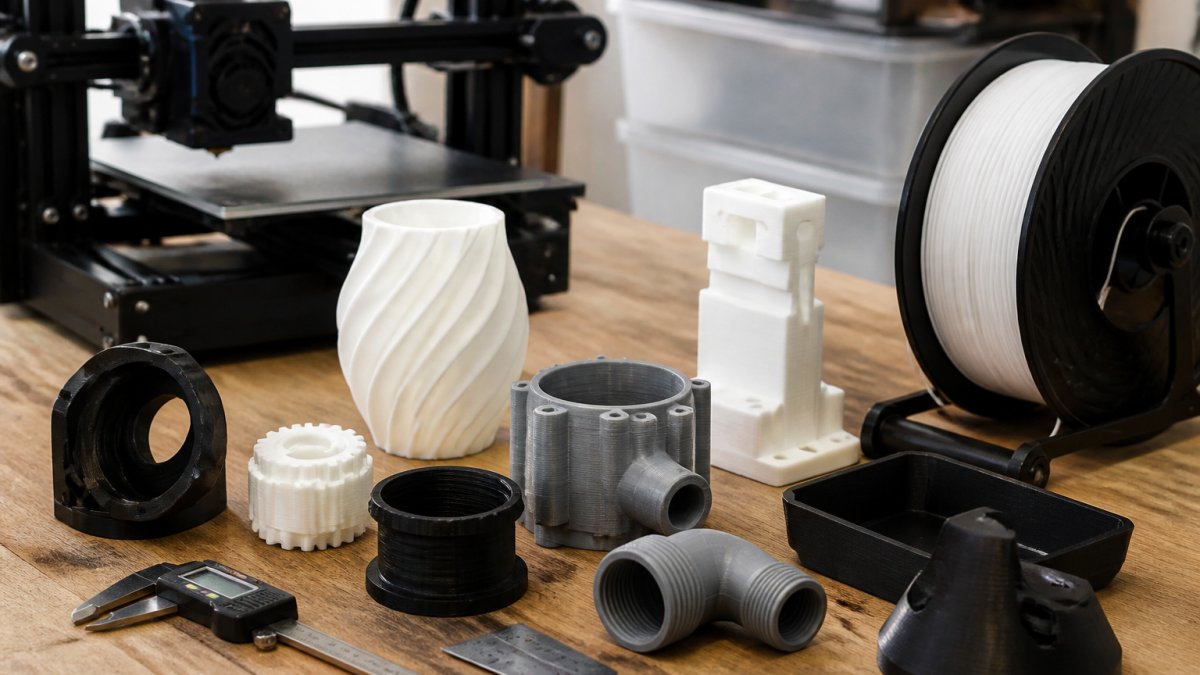
Affordable 3D Printing for Product Design Firms
Table of Contents
- Why Affordable 3D Printing Matters for Product Design Firms
- Comparing 3D Printing Technologies and Materials for Affordable Prototyping
- 3D Printing Cost Estimation for Businesses: What Drives Your Quote
- Outsourcing vs In-House 3D Printing: A Practical Comparison
- Low Volume Manufacturing Risks for Design Firms
- How to Get an Instant Quote and What to Expect
- Post-Processing, Lead Times, and Quality Control
- Frequently Asked Questions
Last Updated: October 1, 2026
Why Affordable 3D Printing Matters for Product Design Firms
Product design teams lose their competitive edge when prototyping costs spiral. Affordable 3D printing for product design firms is the practice of selecting the right additive process, material, and vendor so that each design iteration costs less without sacrificing dimensional accuracy.
Speed compounds the problem. A prototype that takes two weeks to arrive kills a design sprint.
The good news: most of the cost in a 3D printed part is decided before you ever upload a file. Part orientation, wall thickness, material choice, and post-processing needs all drive your quote. Below, we'll show you exactly how to control each one, and how to get an instant quote that reflects real production costs rather than a padded estimate.
Comparing 3D Printing Technologies and Materials for Affordable Prototyping
FDM is the most cost-effective option for early concept models, while SLA, SLS, and MJF each serve specific needs around detail, strength, and volume. Matching the process to the question your prototype must answer is the single biggest lever on cost.
FDM, SLA, SLS, and MJF: Which Fits Your Budget?
FDM (Fused Deposition Modeling) extrudes thermoplastic filament layer by layer. It is the cheapest entry point and ideal for form checks and large, simple parts. Layer lines are visible, so surface finish is rough out of the box.
SLA (Stereolithography) cures liquid resin with a laser, producing fine detail and smooth surfaces. It suits appearance models and small, intricate features. Resin parts can be brittle and degrade in sunlight.
SLS (Selective Laser Sintering) fuses nylon powder into strong, functional parts with no support structures. It handles complex geometry well and works for small batch production.
MJF (Multi Jet Fusion) also uses powder bed fusion, producing parts with consistent mechanical properties and good surface finish at higher volumes.
| Technology | Best For | Relative Cost | Surface Finish |
|---|---|---|---|
| FDM | Concept models, large simple parts | Lowest | Rough, visible layers |
| SLA | Fine detail, appearance models | Low to mid | Smooth |
| SLS | Functional parts, complex geometry | Mid to high | Matte, uniform |
| MJF | Batch production, consistent parts | Mid | Good, uniform |
Material Properties That Affect Cost and Performance
Material selection drives both performance and price. Engineering-grade thermoplastics like ABS and polycarbonate cost more than standard PLA but survive functional testing. Choose the cheapest material that passes your actual test, not the most impressive one on the datasheet.
3D Printing Cost Estimation for Businesses: What Drives Your Quote
3D printing cost estimation for businesses comes down to five variables: material volume, machine time, support structures, post-processing, and quantity. Understanding each one lets you predict a quote before it lands in your inbox.
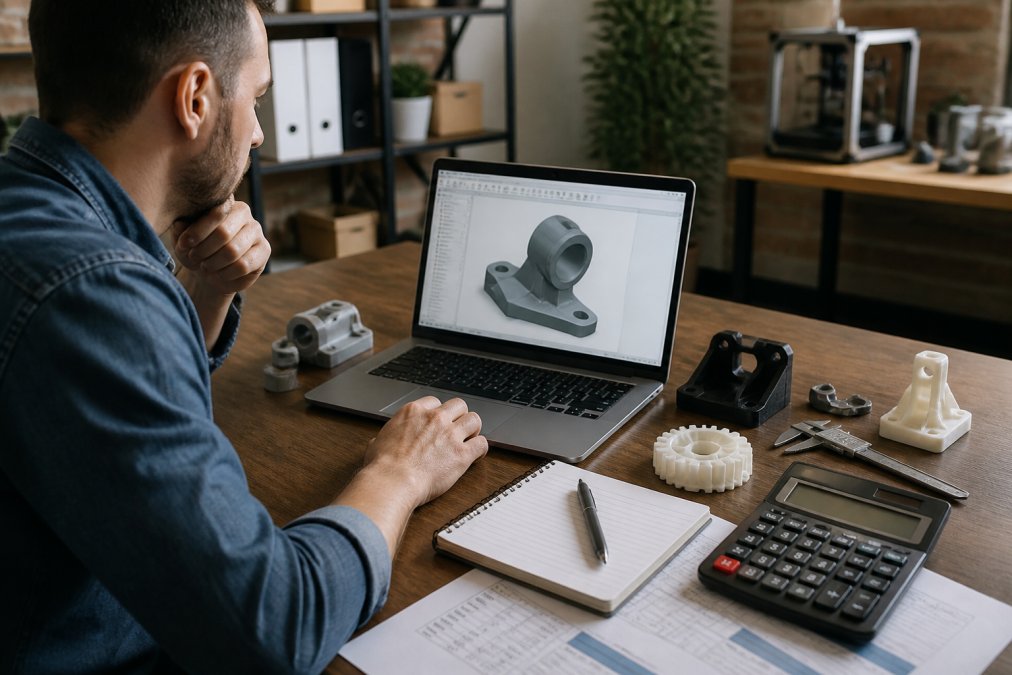
Material volume is the most obvious cost, but it is rarely the largest. A solid part uses far more material than a hollowed one, and most quoting engines bill by the cubic centimeter of material consumed plus the volume of support material. A part that looks small in your CAD viewport can carry a surprising material charge if it is modeled solid.
Machine time matters because build volume is finite. A tall part occupies the machine longer, and powder-bed systems like SLS and MJF bill by the vertical inch of the build chamber rather than the part's own height. Nesting multiple parts in one build spreads that fixed machine time across more units, which is why quantity changes the math so dramatically.
Support structures add both material and removal labor. FDM needs supports under overhangs. That single difference often makes powder-bed processes cheaper than FDM for complex geometry, even though the per-gram material cost is higher.
Post-processing is the line item most designers underestimate. Support removal, sanding, vapor smoothing, dyeing, and laser engraving are frequently quoted separately, and on a small part the finishing can rival the print cost itself. Ask for a line-item breakdown rather than a single lump sum.
Quantity changes everything, since setup costs spread across more units. A one-off part carries the full setup burden; a batch of twenty amortizes it. This is why ordering three to five parts to test a vendor is usually cheaper per unit than ordering one.
Design for Additive Manufacturing (DfAM) to Lower Costs
Design for Additive Manufacturing is the practice of shaping parts around what 3D printing does well, which cuts cost before a file ever reaches a vendor. A common mistake is designing a part as if it will be machined, then paying for supports and wasted material. The fixes are mechanical, not artistic:
- Hollow thick sections. A solid block of resin or nylon is mostly wasted material. Shell it to a wall thickness that matches the load path, typically 2-3 mm for functional parts, and add drain holes so trapped resin or powder can escape.
- Orient parts to minimize supports. Rotating a part so its largest flat face sits on the build plate can eliminate most support material. In FDM, orienting so layer lines run perpendicular to the primary load direction also improves strength.
- Combine assemblies into single printed parts. A bracket that would be three machined pieces and four fasteners can often print as one part with integrated living hinges or snap fits. Fewer parts means fewer setups, fewer fasteners, and less assembly labor.
- Use topology optimization or lattice infill. Most CAD tools and several free plugins can reduce material where stress is low. A lattice infill at 15-20% density often passes the same functional test as a solid part at a fraction of the material cost.
- Design to the process tolerance. If your part needs a 0.005-inch tolerance, you are paying for a process that can hold it. If a 0.015-inch tolerance passes the test, FDM will cost far less than machining.
These changes routinely turn an expensive quote into an affordable one. The designers who get the lowest quotes are not the ones who shop the most vendors; they are the ones who optimize the file before uploading it.
Integrating Quoting Into Your CAD Workflow
A growing number of design firms skip the upload-and-wait cycle entirely by pulling quoting into the CAD environment. Several online manufacturing services publish plugins for SolidWorks, Fusion 360, and Onshape that let you select a body, choose a material and process, and see a live price without leaving the modeling window. The practical benefit is iteration speed: you can adjust a wall thickness or reorient a part and watch the price change in seconds, which turns cost optimization into a design habit rather than an afterthought.
If your CAD tool does not have a native plugin, the next best option is a vendor with a browser-based instant quote that accepts STEP files directly. STEP preserves solid geometry and units, so it avoids the mesh errors that plague STL uploads and gives you a more accurate price on the first try.
Autodesk Fusion 360 additive manufacturing workspace documentation
Upload your STL file for an instant quote →
Outsourcing vs In-House 3D Printing: A Practical Comparison
Outsourcing wins for most design firms on cost and capability, while in-house printing wins on same-day iteration. The right answer depends on how often you print and how complex your parts are.
An in-house FDM printer makes sense if you run daily form checks and your parts are simple. The moment you need tight tolerances, multiple materials, or post-processing like laser engraving, in-house becomes a bottleneck. Outsourcing to a turnkey service gives you access to finishing under one roof, without capital outlay or maintenance downtime. For startups and mid-sized firms, outsourcing usually delivers better parts at a lower total cost.
Low Volume Manufacturing Risks for Design Firms
Low volume manufacturing risks include per-unit cost inflation, inconsistent quality across small batches, and lead-time surprises. These risks are manageable when you plan for them.
Small batches carry higher per-unit costs because setup is spread across fewer parts. Quality can drift between runs if the vendor changes machines or operators. Lead times stretch when a shop prioritizes large orders over yours. Mitigate all three by locking in a vendor relationship, requesting a first-article inspection, and ordering slightly ahead of your true deadline.
How to Get an Instant Quote and What to Expect
An instant quote gives you a real price in minutes when you upload a valid STL file with correct units and scale. Here is the standard process.
- Export your model as an STL or STEP file from your CAD software
- Confirm units and scale match your design intent
- Upload the file to a quoting system
- Select material, technology, and quantity
- Review the price, lead time, and included services
- Approve and confirm the order
Most quoting engines return a price within seconds. The key is file readiness. A model with reversed normals or non-manifold edges will either fail to quote or quote incorrectly.
Post-Processing, Lead Times, and Quality Control
Post-processing, lead times, and quality control are where affordable quotes quietly become expensive ones. Ask what is included before you approve, and ask for the finishing line items separately.
Post-Processing Cost Breakdown
Post-processing is the least transparent part of a 3D printing quote, and it is often the largest variable after material. Here is what each step typically involves and how it affects the invoice:
| Finishing Step | What It Involves | Cost Driver |
|---|---|---|
| Support removal | Breaking away or dissolving supports | Labor time, part complexity |
| Sanding | Hand or orbital sanding of layer lines | Surface area, target smoothness |
| Vapor smoothing | Solvent vapor to melt layer lines (ABS, some resins) | Part size, solvent handling |
| Dyeing | Immersion dye for uniform color (nylon, some resins) | Batch size, color consistency |
| Painting | Primer plus color coats | Color count, masking complexity |
| Laser engraving | UV or MOPA laser for logos and text | Engraving area, depth, setup |
| Tumbling / media finishing | Abrasive media for uniform matte finish | Cycle time, media type |
A few practical rules of thumb. Support removal is usually included in the print price for FDM. Sanding is billed by the hour and scales with surface area, so a large flat panel costs more to sand than a small intricate part. Vapor smoothing is only available for certain materials and adds a day or more to lead time. Dyeing is priced per batch, so it is cheapest when you dye many parts at once. Laser engraving carries a setup charge plus a per-area charge, which is why engraving a small logo on a large part is often cheaper than engraving the same logo on many small parts.
The single most useful habit is to request a line-item quote that separates print, support removal, finishing, and inspection. A vendor that will not break out finishing is a vendor whose finishing cost you cannot control.
For branded promotional pieces and trade-show items, finishing matters as much as the print itself. Alex 3D Print Us LLC handles multi-color printing on Bambu Lab machines plus UV and MOPA laser engraving, so prototypes and branded parts come from a single vendor instead of bouncing between shops.
Lead Times by Process
Lead time depends on the process and the queue. As a general pattern:
- FDM: often the fastest, sometimes same-day for small parts, because the machine is simple and the queue is short.
- Finishing: adds time on top of print time. Sanding, dyeing, and vapor smoothing each add a day or more.
The practical takeaway is to order slightly ahead of your true deadline and to ask the vendor when the next build is scheduled, not just how long the print takes.
Quality Control and Precision Standards
Quality control is the step that separates a reliable vendor from a cheap one. Ask what inspection is included and what it costs.
- Dimensional inspection: for functional parts, request measurement of critical features against your drawing. This is often a paid add-on, but it is cheaper than discovering a batch is out of tolerance after assembly.
- First-article inspection: for any batch you plan to repeat, request a first-article report on the first unit. This locks in the process before the rest of the batch runs.
- Material certification: for regulated or safety-critical parts, ask for the material lot and any available test data.
- Visual inspection: standard on most orders, but confirm whether it covers all surfaces or only the primary faces.
A common pattern is that the cheapest quote omits inspection entirely, and the cost of a failed batch exceeds the savings on the quote. Build inspection into your vendor selection criteria, not your post-mortem.
| Stage | What It Covers | Typical Impact |
|---|---|---|
| Print setup | File prep, orientation, supports | Fixed cost per order |
| Production | Machine time and material | Scales with volume |
| Post-processing | Sanding, dyeing, engraving | Can rival print cost |
| Quality control | Inspection, first-article report | Protects batch consistency |
Frequently Asked Questions
How can product design firms reduce 3D printing costs?
Product design firms can cut costs by optimizing part geometry for additive manufacturing, choosing the right material for the application rather than over-specifying, and batching similar parts in a single build. Design for Additive Manufacturing (DfAM) techniques like reducing support structures and orienting parts to minimize build time also lower costs. Getting an instant quote early in the design phase helps identify cost drivers before committing to a full production run.
Is outsourcing 3D printing cheaper than buying an in-house printer?
Outsourcing is often more cost-effective for firms with variable demand or limited capital. In-house printers require upfront equipment costs, material inventory, maintenance, and skilled operators. For occasional prototyping or low volume runs, outsourcing gives access to industrial-grade technologies without the overhead. However, if you print daily and need tight control over turnaround, in-house may pay off. Many firms use a hybrid approach.
What are the risks of low volume manufacturing for design firms?
Low volume manufacturing risks include higher per-unit costs, limited material choices, inconsistent quality between batches, and longer lead times if the supplier prioritizes large orders. Design firms also face the risk of design changes mid-production, which can increase costs. Mitigate these by validating designs with rapid prototyping first, choosing a supplier experienced with small batches, and confirming tolerances and surface finish requirements upfront.
What materials are best for affordable functional prototypes?
For affordable functional prototypes, thermoplastics like PLA and PETG work well for FDM prints with basic mechanical needs. Nylon and TPU offer flexibility and durability for functional testing. The best choice depends on your part's mechanical requirements, tolerance needs, and budget.
Product design teams face a real squeeze: prototypes must be fast, accurate, and cheap, and most vendors only deliver two of the three. Alex 3D Print Us LLC closes that gap with turnkey engineering and design support, Bambu Lab multi-color printing, and xT