

PLA or PETG for Outdoor Signs in 2026: Which Should You Choose?
Quick Summary
For most outdoor signs, PETG is the better choice over PLA because it handles heat and moisture far better. PLA softens at fairly low temperatures and fades quickly in direct sun, so it suits only short-term or indoor use. Choosing between pla or petg comes down to how much sun and heat the sign will face.
- PLA softens at fairly low temperatures, so dark signs in summer sun can warp or sag.
- PETG resists heat, impact and moisture better than PLA and is often chosen for simple outdoor signs.
- PETG still yellows and dulls with long direct sun exposure, so choose light or medium colors.
- ASA has much better UV resistance than PETG and suits signs facing direct sun for years.
- Test a small coupon at the mounting location for a few weeks before committing to a full print.
Table of Contents
- Last Updated: November 7, 2026
- Why Outdoor Signs Fail: Heat, UV and Moisture
- PLA vs PETG: Pros and Cons for Outdoor Use
- PETG UV Resistance: What to Expect in Direct Sunlight
- When ASA vs PETG for Outdoor Signage Makes Sense
- Designing a 3D Printed Outdoor Sign That Lasts
- Step-by-Step: Choosing the Right Filament for Your Sign
- Order a Weather-Ready Sign: Upload Your STL for an Instant Quote
- Frequently Asked Questions
Last Updated: November 7, 2026
Last Updated: November 7, 2026
Choosing between PLA and PETG for outdoor signage in 2026 comes down to one question: will the sign still look good after a year in the sun, rain and heat? For most buyers, the pla or petg decision decides how long the sign lasts. Most outdoor failures come from choosing the wrong material, so the filament decision matters as much as the print itself.
A sign is a fixed object outside, so it faces three threats at once: heat, UV light and moisture. Each one breaks plastic in a different way, and the right filament depends on which threat hits your location hardest.
Why Outdoor Signs Fail: Heat, UV and Moisture
Heat is the first problem. A sign mounted on a south-facing wall can get much hotter than the air around it. PLA softens at a fairly low temperature, so a dark sign in summer sun can warp or sag.
UV light is the second problem. Sunlight slowly breaks down the chemical bonds in plastic. Over months, colors fade, surfaces chalk, and edges turn brittle.
Moisture is the third. Rain, morning dew and humidity do not destroy most filaments quickly, but they make a weak print weaker over time, especially at layer lines.
- Heat causes warping and sagging
- UV causes fading and brittleness
- Moisture weakens layer bonds over time
PLA vs PETG: Pros and Cons for Outdoor Use
PLA and PETG are the two most common desktop filaments, and the pla or petg choice matters most outside. They look similar on a shelf, but they behave very differently in the weather.
PLA Pros and Cons
PLA is generally considered easy to print, with good adhesion and sharp detail, which makes it a common choice for indoor prototypes and display pieces.
For outdoor use, PLA has clear limits:
- Pros: Easy to print, crisp detail, low cost, good color range
- Cons: Low heat resistance, weak UV resistance, can become brittle in cold and sun
A common mistake is choosing PLA because it prints easily, then mounting the sign where direct sun hits it all afternoon. It may look fine for a season, then soften or fade.
PETG Pros and Cons
PETG sits between PLA and the tougher engineering plastics. It handles more heat, resists impact better, and holds up better to moisture. It is often chosen for simple outdoor signs.
- Pros: Better heat resistance than PLA, good impact strength, tolerates moisture well, easier to print than ABS
- Cons: Stringing and blobbing are common, UV resistance is good but not perfect, surfaces can scratch
In practice, PETG is the safer pick for most outdoor signs where PLA would be a risk. It is not immune to sun, though, which leads to the next question.
PETG UV Resistance: What to Expect in Direct Sunlight
PETG resists UV better than PLA, but it still yellows and dulls with long exposure. A sign in full sun for years will show some change in color and gloss.
To get the best result from PETG outdoors:
- Choose light or medium colors, which hide fading better than deep black or red
- Use an extra outer layer or a clear UV-stable coating where you can
- Use thick walls and solid infill so the sign keeps its strength as the surface ages
- Mount the sign with airflow behind it so heat does not build up
Watch out: dark PETG signs in direct sun can heat up enough to deform even though the plastic itself is rated to handle heat. Mount them with space behind, and avoid placing them flat against hot surfaces.
When ASA vs PETG for Outdoor Signage Makes Sense
ASA is designed for outdoor use. It has much better UV resistance than PETG and handles heat well. If a sign must look good for several years in strong sun, ASA is often the better choice.
ASA is harder to print. It needs a heated bed, an enclosure to avoid cracking, and good ventilation because of its fumes. Not every desktop printer handles it well.
Choose PETG when:
- The sign is in partial shade or a covered area
- You want an easy-to-print, budget-friendly option
- The sign will be replaced or refreshed within a few years
Choose ASA when:
- The sign faces direct sun for long hours
- You need a longer outdoor life with stable color
- Your printer and setup can handle higher-temperature printing
Designing a 3D Printed Outdoor Sign That Lasts
Material choice sets the ceiling on outdoor life, but geometry decides whether the sign reaches that ceiling. Large signs fail at the same handful of places: mounting holes, sharp internal corners, long unsupported spans, and the layer seams that run across a bending load.
Orientation and layer direction. FDM parts are weakest between layers, so orient the sign so layer lines run perpendicular to the main bending or pull-out load rather than parallel to it.
Wall count and infill. Thin walls and low infill are the first things to fail outdoors. For a sign that will see sun and wind, thicker walls and higher infill in load-bearing regions are generally advisable.
Stress concentration. Sharp internal corners concentrate stress and crack under thermal cycling. Add fillets at every inside corner, especially where a mounting boss meets the panel.
Seams. Place the seam on a hidden edge or the back face. A seam on the front face becomes a visible line that also collects moisture and UV exposure, and it is often where surface cracking starts.
Panelization for large signs. Signs longer than the printer's build volume should be split into panels joined with bolts, brackets, or a backing frame, not glued edge-to-edge.
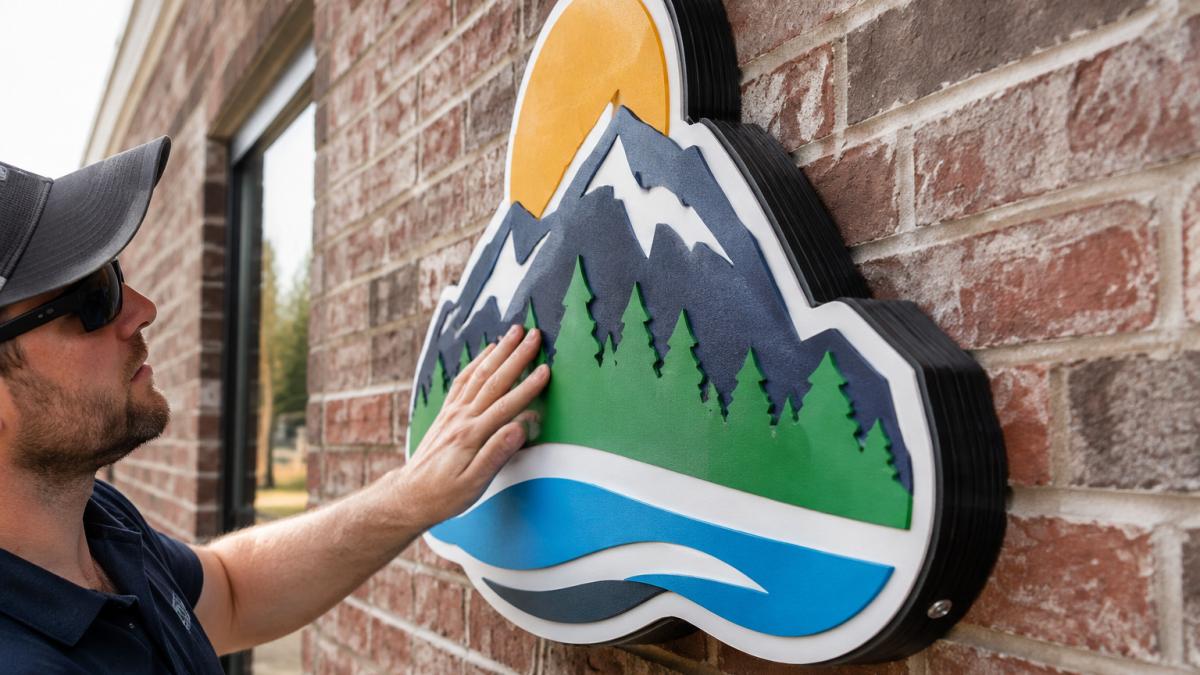
Drainage and airflow. A sign mounted flat against a wall traps heat and moisture.
Step-by-Step: Choosing the Right Filament for Your Sign
Use this as a decision workflow, not a one-time checklist. The goal is to pick a material, then prove it with a test coupon before you commit a long print to a sign.
Step 1: Diagnose the exposure, not just the climate. Note direct-sun hours per day, whether the sign faces south or west, whether it is mounted on masonry or a dark surface that radiates heat, and whether it sits under an overhang.
Step 2: Separate the two failure modes before you blame the filament. Outdoor failures split into bed-adhesion problems (corners lifting, the part detaching mid-print) and interlayer-bond problems (the part holds shape but splits along layer lines or snaps at a seam). If corners lift, the fix is first-layer and bed adhesion: clean the build plate, check first-layer squish, add a brim, and manage chamber drafts. If the part splits between layers, the fix is thermal and flow: raise hotend temperature in small steps, slow the print, reduce part-cooling fan on the lower layers, and calibrate extrusion flow.
Step 3: Set material-specific starting points, then validate. These are starting ranges, not guarantees; every printer and filament spool differs, so run a test coupon first.
- PLA: hotend roughly 200-220 °C, bed 50-60 °C, part-cooling fan high after the first few layers. PLA is the easiest to print but has the lowest heat resistance, so treat it as an indoor or short-term outdoor option.
- PETG: hotend roughly 230-250 °C, bed 70-85 °C, part-cooling fan moderate (too much fan weakens layer bonding), print speed slower than PLA. PETG bonds well but strings; dry it if it has been exposed to humid air.
- ASA: hotend roughly 250-270 °C, bed 90-110 °C, enclosure strongly recommended to prevent cracking, minimal part-cooling, and ventilation for fumes. ASA is the long-term direct-sun choice but the hardest to print reliably.
Step 4: Match the material to lifespan and budget. A temporary event sign can use PLA. A permanent sign in partial shade is a good PETG job. A permanent sign in full sun for years points to ASA. Price the whole job, not just the spool: a failed long print costs more in machine time than the filament difference.
Step 5: Test and document before the full print. Print a small coupon at the settings you plan to use, leave it at the actual mounting location for a few weeks, and inspect it for warping, color shift, and surface cracking.
Step 6: Check the hardware before a long job. Large signs mean long print times, and long prints expose hardware weaknesses: a worn nozzle, a loose extruder tension arm, a long Bowden path with drag, or a hotend that cannot hold temperature will ruin a multi-hour print. Confirm temperature stability and extrusion consistency on a short test before starting the sign.
| Material | Best For | Sun Resistance | Ease of Printing |
|---|---|---|---|
| PLA | Indoor or short-term use | Low | Very easy |
| PETG | Shaded or covered outdoor signs | Moderate | Easy |
| ASA | Long-term direct sun | High | Harder |
Watch out: raising hotend temperature to fix a bed-adhesion problem will not help and can make stringing and sagging worse; confirm which failure mode you have before changing settings.
Order a Weather-Ready Sign: Upload Your STL for an Instant Quote
If you want a sign that holds up outdoors, the material choice is only the start. Upload your STL file for an instant quote, and we will help you match the filament to your location and use.
Pricing depends on size, material, quantity and finish, so we recommend uploading your file to get a current quote from the Alex 3D Print Us LLC website. You can also review the printers and materials available for custom sign work.
Frequently Asked Questions
Is PLA or PETG better for outdoor signs?
PETG is generally the better choice for outdoor signs because it tolerates higher temperatures and moisture better than PLA. PLA is brittle, softens at relatively low temperatures, and can deform in a parked car or in direct summer sun. PETG handles temperature swings and rain more reliably, though it still degrades under long UV exposure unless protected with paint or a UV-resistant coating. For short-term indoor or event signage, PLA is cheaper and easier to print. For anything that must stay outside for months, PETG is the safer default.
How long does PLA last outdoors?
PLA typically holds up for only a limited period outdoors before it becomes brittle, discolors, or warps, especially in direct sun and summer heat. Its glass transition temperature is low, so it can soften in hot conditions. Exact lifespan depends on climate, sun exposure, and whether the part is painted or coated. For durable outdoor signage, PETG or ASA is the more practical choice, and PLA should be reserved for temporary or indoor use.
Does PETG hold up in sunlight and rain?
PETG resists rain and moisture well and handles outdoor temperature swings better than PLA. Long-term UV exposure still causes yellowing and surface degradation, so a UV-resistant clear coat or paint over the print extends its appearance. Using a dark or pigmented filament also slows UV damage. Print orientation matters too: layer lines facing the sun wear faster, so orient the sign face to minimize exposed seams.
When should I use ASA instead of PLA or PETG for outdoor signage?
Choose ASA when the sign will face constant direct sunlight, high heat, or long-term UV exposure, since it resists UV and heat better than PETG. ASA requires an enclosed printer and good ventilation because it emits fumes during printing. If your printer cannot be enclosed, PETG with a protective coating is a practical alternative. For most small outdoor signs, PETG offers a reasonable balance of ease of printing and durability.
