
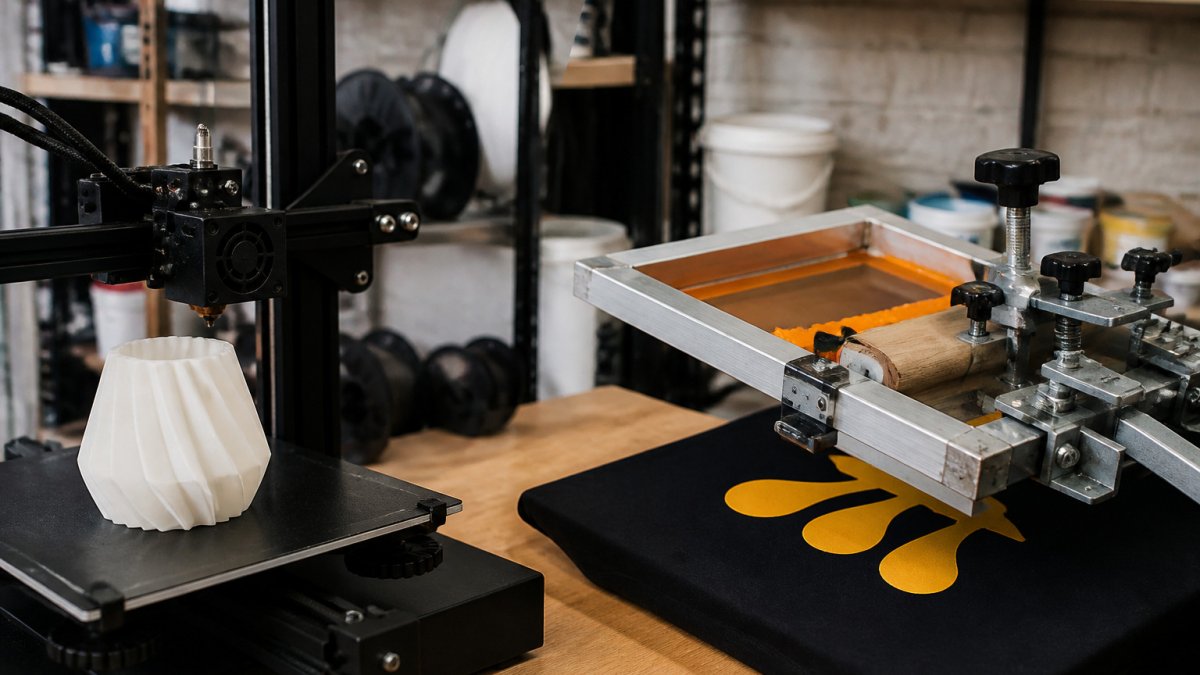
3D Printing vs Screen Printing: Merchandise Guide
Last Updated: November 4, 2026
Quick Summary
The 3d printing vs screen printing choice comes down to the job: 3D printing builds a three-dimensional object layer by layer, while screen printing pushes ink through a mesh stencil onto a flat surface like a garment. One makes the object, the other decorates it, so screen printing suits bulk flat apparel and 3D printing suits shaped or textured products.
- Screen printing front-loads cost into setup, while 3D printing front-loads cost into machine time.
- A 50-piece run of a 3D-printed desk piece often costs roughly the same per unit as a 5-piece run.
- Screen printing wins on wash resistance for high-density, multi-color designs on cotton and blends.
- Sublimation only bonds to high-polyester surfaces, and DTG performs best on 100% cotton.
- A 3D-printed screen printing frame lets small shops produce short-run custom designs without a metal frame.
Table of Contents
- 3D Printing vs Screen Printing: Two Different Jobs
- How Screen Printing and Digital Garment Printing Work
- Screen Printing vs Heat Press vs Digital Printing
- Cost Model: Setup, Per-Unit Cost, and Minimum Order
- Screen Printing vs Heat Transfer Durability and Wash Resistance
- 3D-Printed Promotional Products: Where the Method Wins
- The 3D-Printed Screen Printing Frame: A Hybrid Workflow
- Upload Your STL File for an Instant Quote
- Frequently Asked Questions
3D Printing vs Screen Printing: Two Different Jobs
The 3D printing vs screen printing comparison trips up a lot of marketing teams, and the confusion starts with the word "printing." These are two separate production methods that solve two separate problems.
3D printing is an additive manufacturing process that builds a three-dimensional object layer by layer from a digital file (What is Additive Manufacturing? | NIST). Screen printing is a decoration method that pushes ink through a mesh stencil onto a flat surface, usually a garment.
One makes the object. The other puts a design on it. That distinction decides almost every question that follows.
How Screen Printing and Digital Garment Printing Work
Screen printing and digital garment printing both put ink on fabric, but they get there in very different ways. The method you pick changes your setup cost, your minimum order, and how fine your artwork can go.
Screen Printing: Mesh, Ink, and a Squeegee
A mesh screen is stretched over a frame and coated with emulsion. Your design is burned into that emulsion, leaving open areas where ink can pass. A squeegee pulls ink across the screen, and the ink transfers through the open mesh onto the garment.
Each color needs its own screen, and each screen needs its own registration so the colors line up. That is why color count drives both setup cost and production time.
Digital Printing: DTG, DTF, and Sublimation
Digital methods skip the screens entirely. Direct-to-garment (DTG) printing sprays ink straight onto the fabric. Direct-to-film (DTF) prints onto a film that gets heat-pressed onto the garment. Sublimation uses heat to turn dye into gas so it bonds with polyester.
No screens means no setup per color. A full-color photographic design costs the same to set up as a two-word logo. The trade-off shows up at volume, where screen printing's per-unit cost drops and digital's stays flat.
Screen Printing vs Heat Press vs Digital Printing
The screen printing vs heat press vs digital printing question usually comes down to order size and design complexity. Screen printing wins on bulk orders of simple designs. Digital printing wins on small batches and detailed artwork. Heat press sits in the middle as a finishing step that applies vinyl, transfers, or DTF film to a garment.
Here is how the three compare on the factors that actually drive a purchasing decision:
| Method | Setup Cost | Best Order Size | Color Flexibility | Detail Level |
|---|---|---|---|---|
| Screen printing | Per screen, per color | Large runs | Costly beyond a few colors | Bold, simple shapes |
| Heat press / vinyl | Low | Small to medium | Limited by cut vinyl | Moderate |
| Digital (DTG/DTF) | Minimal | Small runs, one-offs | Unlimited | High, photographic |
A common mistake is choosing screen printing for a 25-piece run with a six-color design. The setup charges alone can make the per-unit cost look nothing like the quote you expected.
Cost Model: Setup, Per-Unit Cost, and Minimum Order
Most guides stop at "screen printing is cheaper in bulk, digital is cheaper for small runs." That is true but useless when you are actually budgeting a merchandise program. The real question is where the cost curves cross, and how 3D printing fits into the same budget. Here is the side-by-side model the top results skip.
The three cost buckets
Every merchandise job, regardless of method, carries the same three cost buckets. What changes is how much lands in each one.
- Setup or tooling: screens and emulsion prep for screen printing; none for DTG/DTF; model prep, slicing, and sometimes supports or jigs for 3D printing.
- Per-unit materials and machine time: ink and garment for screen printing; ink and pretreat for DTG; filament or resin plus print hours for 3D printing.
- Labor and finishing: screen reclaim, registration, and curing; heat-press dwell time for DTF; support removal, post-curing, and assembly for 3D printing.
Screen printing front-loads cost into setup. 3D printing front-loads cost into machine time. Digital garment printing spreads cost evenly because there is almost no setup and no long machine cycle per piece.
How the curves behave at different order sizes
3D printing behaves differently again. Per-unit cost is dominated by print time and material mass, so it barely moves with quantity unless you invest in a print farm or multi-part nesting. A 50-piece run of a 3D-printed desk piece often costs roughly the same per unit as a 5-piece run, because the machine still has to print each one.
Minimum order quantities
Screen printers often set a floor because short runs do not cover screen prep and reclaim. Digital shops can print a single item. 3D printing has no minimum in the traditional sense, a one-off is normal, but the effective minimum is one print bed, since batching parts on a single plate is how you make the economics work.
What actually moves your quote
Four variables drive the number on any quote, and they apply to both methods:
- Quantity: the single biggest lever for screen printing, the smallest for 3D printing.
- Color count: each screen adds setup and a pass; multi-color 3D printing adds filament changes and purge waste rather than screens.
- Material: garment blank cost for screen printing; filament type, infill, and supports for 3D printing.
- Turnaround: rush jobs add labor on both sides, but 3D printing's long machine cycles make rush work harder to absorb.
Watch out: comparing a screen-printing quote that excludes screen charges against a 3D-printing quote that excludes model prep and post-processing will make either method look artificially cheap. Ask both vendors for an all-in landed cost at your actual quantity.
Upload your STL file for an instant quote →
For a fuller breakdown of how setup and per-unit costs interact on low-volume jobs, see our guide to small batch custom fabrication pricing. Pricing depends on quantity, colors, material, and turnaround, so the reliable move is to get a quote against your actual artwork.
Screen Printing vs Heat Transfer Durability and Wash Resistance
Durability is where the method names mislead people. A screen print and a heat transfer can both last years or both fail in five washes, because the outcome depends on the ink chemistry, the substrate, and the cure, not the label on the process. The useful comparison is not "which method is tougher" but "which method is tougher on this material, with this geometry, under this use pattern."
What actually determines longevity
Three variables decide whether a decoration survives handling and washing:
- Cure and press parameters: undercured screen ink washes out; an under-pressed transfer peels. Most failures trace to process control, not material choice.
- Substrate match: sublimation only bonds to high-polyester surfaces. DTG performs best on 100% cotton. Screen printing handles a wider range, which is why it remains the default for team uniforms and event apparel.
Durability by merchandise category
This is where the 3D-printing side of the comparison finally enters, and where most guides go silent.
- Flat apparel (T-shirts, hoodies, totes): screen printing wins on wash resistance for high-density, multi-color designs on cotton and blends. Heat transfer is fine for low-volume and one-offs but is the first to show edge wear.
- Curved and 3D surfaces (bottles, tumblers, caps, hard goods): screen printing can wrap a cylinder with a rotary attachment, but complex curvature and undercuts defeat it. Pad printing or UV printing usually replaces it. 3D printing sidesteps the problem by building the shape and the branding together.
- Shaped objects (figurines, desk pieces, functional parts, accessories): there is no screen-printing equivalent. Durability here means layer adhesion, infill, and UV stability of the filament or resin, not ink wash fastness.
- Raised or textured effects: screen printing can lay down a high-density raised print that survives handling. 3D printing produces true relief geometry that cannot peel because it is the object, not a film on it.
The geometry constraint nobody tables
A simple decision rule covers most merchandise briefs:
| Surface / product | Screen printing fit | 3D printing fit |
|---|---|---|
| Flat fabric, 1-3 colors, bulk | Strong | Not applicable |
| Flat fabric, photographic detail, small run | Weak (setup cost) | Not applicable, use DTG/DTF |
| Curved hard goods, simple wrap | Possible with fixtures | Strong if the part is printed, not decorated |
| Complex geometry, undercuts, moving parts | Not feasible | Strong |
| Raised relief branding | High-density ink only | Native |
Watch out: assuming a 3D-printed part is automatically more durable than a decorated one. Layer adhesion, infill percentage, and UV exposure drive 3D-printed longevity far more than the print method itself, and a poorly oriented print can delaminate under the same handling a screen print shrugs off.
Wash and handling testing
For apparel, the practical test is a standard home-laundry cycle repeated across a sample, checking for cracking, fading, and edge lift. For 3D-printed merchandise, the equivalent is drop, flex, and UV-exposure testing on a sample batch. Neither test is expensive, and both beat guessing from a spec sheet.
Fabric compatibility matters as much as the print method. Sublimation only works on high-polyester surfaces. DTG performs best on 100% cotton.
3D-Printed Promotional Products: Where the Method Wins
Screen printing decorates a surface. 3D printing builds the object, which opens a category of merchandise that flat decoration cannot touch. Multi-color 3D printing produces dimensional branded pieces: desk accessories, custom nameplates, trade-show giveaways with real geometry, and functional items a buyer keeps.
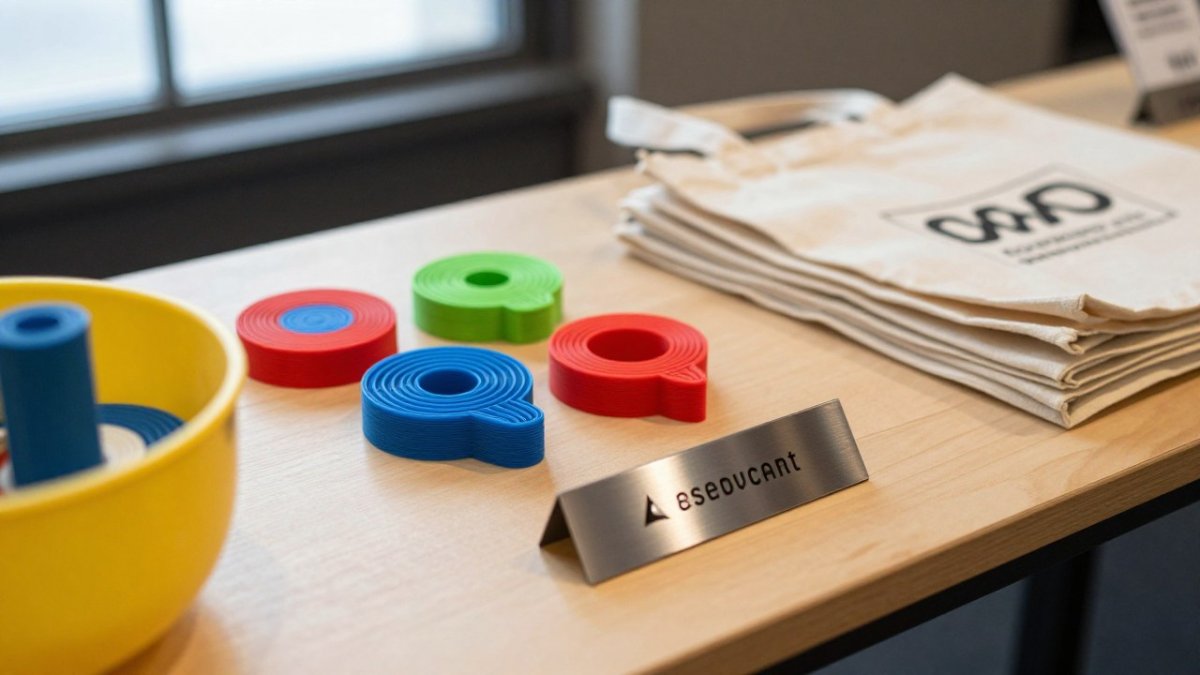
3D printing suits products with shape, texture, or a raised effect. If you want concrete ideas to act on, our list of custom promotional products for corporate events covers the formats that perform.
The 3D-Printed Screen Printing Frame: A Hybrid Workflow
Here is the angle most guides miss: 3D printing can serve screen printing directly. A 3D-printed screen printing frame or a 3D-printed stamp lets a small shop produce short-run, custom designs without ordering a metal frame or waiting on a stencil service.
For the decoration options we offer, including xTool UV and MOPA laser engraving, review our services.
Upload Your STL File for an Instant Quote
The practical way to settle 3D printing vs screen printing for your project is to price both against your real design.
You can upload your STL file for an instant quote for custom 3D printing, laser engraving, and UV printing.
At Alex 3D Print Us LLC, we handle multi-color Bambu Lab printing, xTool UV and MOPA laser engraving, and turnkey design support for projects of any complexity. Upload your file for an instant quote.
Frequently Asked Questions
Do 3D-printed items sell well as merchandise?
They sell when the object itself is the draw: desk pieces, nameplates, display stands, and low-volume branded accessories that buyers keep. Match the method to the product.
Is screen printing more durable than heat transfer?
Print durability depends on the ink, the fabric, and how the print is cured. Washing garments inside out in cold water and skipping the dryer generally helps any print last longer.
Can you 3D print a T-shirt?
Not in the way most people mean. 3D printers extrude filament into solid shapes, so they cannot produce a soft knit garment.
When is screen printing more cost-effective for custom merchandise?
Pricing depends on quantity, colors, material, and turnaround. Request a quote for your design and quantity to see current pricing.
