
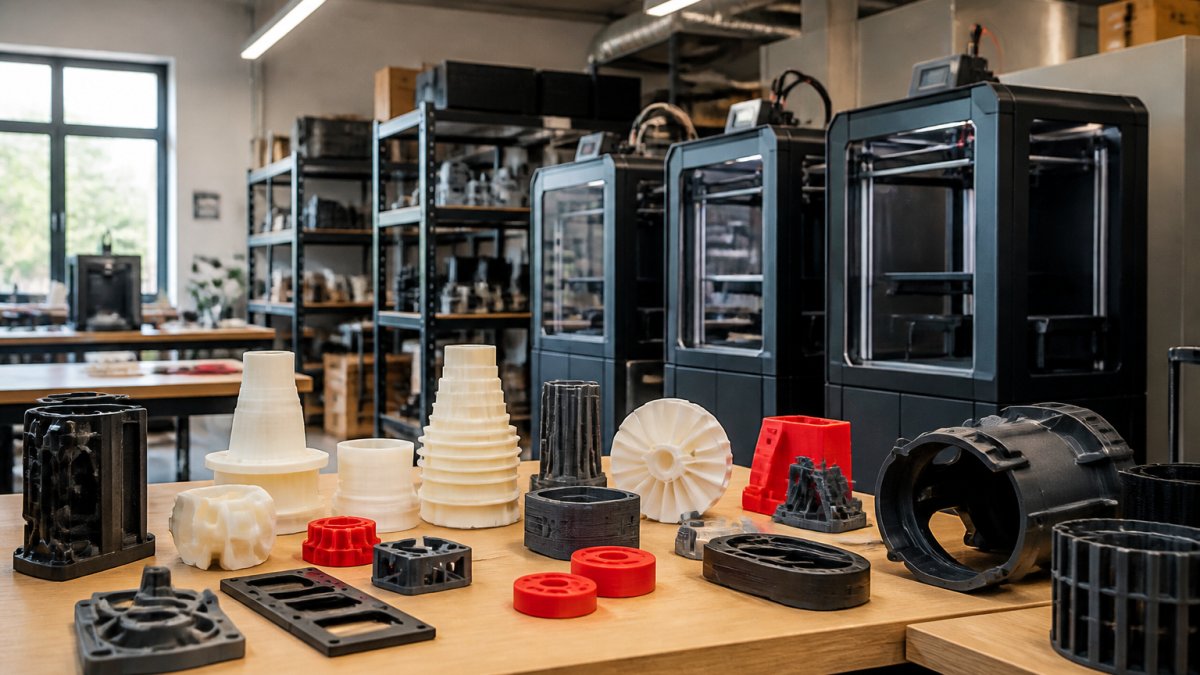
Which 3D Printing Technology Should You Choose for Production?
Last Updated: October 26, 2026
Quick Summary
Choosing the right 3D printing technology production method depends on part function, volume, and budget. The three core processes, FDM for speed and cost, SLA for detail and surface finish, and SLS for durable functional parts, each excel in different scenarios; score your requirements against all three to find the best fit.
- FDM is fastest and cheapest per part but produces rough surfaces; SLA offers exceptional detail but brittle parts; SLS creates durable functional parts but costs more and runs slower.
- At low volumes (50-500 units), 3D printing beats injection molding; at thousands of units, molding's per-part cost justifies tooling investment.
- Cost per usable part, not printer price, determines the winner; account for labor, post-processing, scrap, and material waste in your total cost model.
- Design for 3D printing by using 1-2mm minimum wall thickness, avoiding sharp internal corners, and minimizing support structures to reduce cost and print time.
- Match the process to your production stage: FDM for prototyping, SLS or SLA for bridge production, and injection molding for high-volume recurring production.
Table of Contents
- How 3D Printing Technologies Differ for Production
- FDM vs SLA vs SLS: Strengths and Limitations
- Best 3D Printing Technology for Manufacturing
- 3D Printing vs Injection Molding Cost: When Each Makes Sense
- Production 3D Printing Design Guidelines
- Production Volume, Throughput, and Break-Even Analysis
- Getting Your Design Ready for 3D Printing Production
- Frequently Asked Questions
How 3D Printing Technologies Differ for Production
Choosing the right 3D printing technology production method depends on what your part needs to do, how many you're making, and your budget.
Three core processes dominate production: filament-based printing (FDM), resin-based printing (SLA), and powder-based printing (SLS). Each builds parts layer by layer differently, shaping part quality, cost, and lead time.
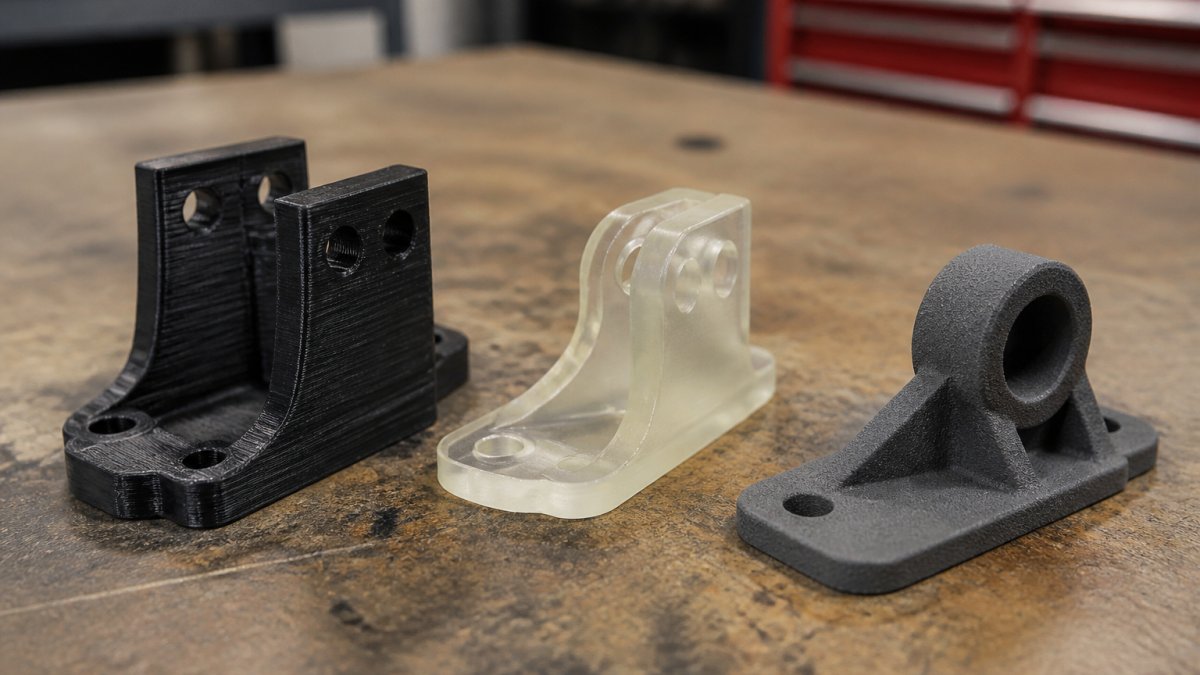
Filament-Based Printing (FDM)
FDM, or Fused Filament Fabrication, is the most accessible additive manufacturing process. It melts thermoplastic filament and deposits it layer by layer through a nozzle.
FDM excels at speed and cost-effectiveness for simple geometries and handles many materials, from standard plastics to engineering-grade thermoplastics. The downside: visible layer lines require post-processing, and dimensional accuracy is looser than competing processes.
Resin-Based Printing (SLA)
Stereolithography uses UV light to cure liquid photopolymer resin into solid parts. A laser traces the part geometry on the resin surface, hardening it one layer at a time as the part lifts and fresh resin flows underneath.
SLA produces exceptional detail and surface finish, with resolution far higher than FDM, ideal for smooth surfaces, fine features, or tight dimensional accuracy. The trade-off is brittleness: most photopolymer resins are less durable than thermoplastics.
Powder-Based Printing (SLS)
Selective Laser Sintering fuses powdered material with a laser. The powder bed acts as support material, eliminating separate support structures, a critical advantage for complex parts.
SLS produces functional, durable parts with excellent mechanical properties and dimensional accuracy, suitable for end-use applications. The downside is cost: equipment and materials are expensive, the process is slower than FDM, and per-part cost becomes significant at high volume.
FDM vs SLA vs SLS: Strengths and Limitations
| Technology | Best For | Speed | Surface Finish | Cost Per Part | Material Strength |
|---|---|---|---|---|---|
| FDM | Fast prototypes, simple parts | Fast | Rough | Low | Moderate |
| SLA | High detail, smooth surfaces | Medium | Excellent | Medium | Low to Medium |
| SLS | Functional parts, complex geometry | Slow | Good | High | High |
FDM Strengths:
- Fastest production speed for most applications
- Lowest material cost per part
- Widest material selection (thermoplastics, flexibles, engineering plastics)
FDM Limitations:
- Rough surface finish requires post-processing
- Weaker parts in certain directions (anisotropic properties)
- Layer lines visible unless post-processed
SLA Strengths:
- Exceptional surface finish and detail resolution
- Tight dimensional accuracy without post-processing
- Complex geometries with fine features
SLA Limitations:
- Parts are brittle and not suitable for high-stress applications
- More expensive than FDM per part
- Limited material options compared to FDM
SLS Strengths:
- Produces functional, durable parts ready for end-use
- No support structures needed (powder acts as support)
- Excellent mechanical properties and dimensional accuracy
SLS Limitations:
- Slowest of the three processes
- Highest equipment and material costs
- Requires post-processing to remove powder
Best 3D Printing Technology for Manufacturing
There is no universally best process, but there is a defensible way to choose one: score each candidate against the requirements that drive production outcomes, part function, volume, tolerance, surface finish, material, and total cost.
A weighted selection matrix
List your requirements, weight each by how much it matters, then score FDM, SLA, and SLS from 1 (poor) to 5 (excellent). Multiply weight by score and sum: the highest total is your starting candidate, the runner-up your fallback.
| Requirement | Example weight | FDM | SLA | SLS |
|---|---|---|---|---|
| Mechanical strength / durability | 25% | 3 | 2 | 5 |
| Surface finish and detail | 20% | 2 | 5 | 3 |
| Dimensional tolerance | 15% | 2 | 4 | 4 |
| Cost per usable part at target volume | 20% | 5 | 3 | 2 |
| Throughput / lead time | 10% | 4 | 3 | 2 |
| Material range and availability | 10% | 5 | 2 | 3 |
Weights are illustrative, replace them with your own. The point is to make trade-offs explicit.
A short decision tree
- Does the part carry load, snap, or see field stress? Start with SLS (or an engineering-grade FDM thermoplastic). Move to SLA only if the load is negligible.
- Is appearance, fine feature detail, or a smooth surface the dominant requirement? Start with SLA. FDM can compete only if you budget for sanding, vapor smoothing, or coating.
- Is the part large, simple, and cost-sensitive at low-to-moderate volume? Start with FDM.
Match the process to the production stage
Production is not one phase. The right process often changes as a program matures:
- Prototyping and design validation: FDM for speed and cost; SLA when form and fit depend on fine detail.
- Bridge production: SLS or SLA when you need end-use-like properties before tooling is committed, and volumes are too low to justify a mold.
- Recurring production: SLS for functional polymer parts at moderate volume; FDM for simple, cost-driven parts; injection molding once volume amortizes tooling.
If you know your requirements, upload your file for an instant quote and we will confirm the process recommendation alongside the price.
3D Printing vs Injection Molding Cost: When Each Makes Sense
Should you 3D print or invest in injection molding tooling? The answer hinges on volume.
Injection molding requires expensive tooling upfront, amortized across every part you make.
3D printing has no tooling cost, so each part costs roughly the same whether you make one or one hundred, cost-effective for small batches and custom runs.
With unpredictable demand or frequent design changes, 3D printing avoids the risk of tooling for a design that might shift.
The break-even point varies by part complexity and size.
Upload your STL file for an instant quote →
Production 3D Printing Design Guidelines
Design for 3D printing technology production requires a different mindset.
Wall thickness matters. Thin walls are risky in FDM and SLS, they may not fuse properly or may be too fragile to handle.
Avoid sharp internal corners. Rounded corners and fillets are easier to print and stronger.
Support structures cost money and time. In FDM and SLA, support material must be added, printed, and removed, so design to minimize it.
Tolerance stacking matters. If your part has multiple features that must fit together, tighter tolerances cost more. Design with realistic tolerances. Achieving Tight Tolerances in 3D Printing: A Step-by-Step Guide covers the technical details.
Production Volume, Throughput, and Break-Even Analysis
Volume decisions fail when they compare printer speed instead of actual output. Tips for Scaling Small Batch Production explores scaling strategies and cost considerations as you move from small batches to production volumes. Real throughput is governed by build utilization, nesting, uptime, finishing, inspection, and labor, so compare processes on capacity and cost per usable part, not spec sheets.
Nominal speed vs. actual throughput
A fast machine that sits idle produces less than a slower one that runs continuously. Estimate actual output with a capacity model:
Actual parts per week = (available machine hours × uptime × build utilization) ÷ (print time + changeover + finishing + inspection time per build) × parts per build
- Uptime: realistic availability after maintenance, failed builds, and setup. Most production shops plan well below 100%.
- Build utilization: the share of the build volume actually filled with parts. Nesting multiple parts per build raises utilization and lowers cost per part.
- Changeover: material swaps, platform prep, and file setup between jobs.
FDM throughput scales linearly with machine count and is easy to parallelize. SLS throughput is governed by build chamber size and run time, a single run may take 12-24 hours, so nesting efficiency matters more than laser speed. SLA throughput depends on build height and layer count, with post-cure and support removal adding fixed time per batch.
Cost per usable part, not cost per part
The number that matters is total cost divided by parts that pass inspection. Build it from:
- Equipment: purchase or lease, depreciation, and financing cost allocated over expected lifetime output.
- Materials: filament, resin, or powder consumed, including support material and powder that cannot be refreshed.
- Labor: operator time for setup, monitoring, depowdering, support removal, and inspection.
Break-even against injection molding
The break-even framework is straightforward:
Break-even volume = tooling cost ÷ (3D-printed cost per usable part − injection-molded cost per part)
Use cost per usable part on the additive side, not the quoted print price. If tooling is 5,000 dollars and molding saves 2 dollars per part, break-even is 2,500 parts, but if 10% of printed parts are scrapped, the effective printed cost rises and break-even moves lower.
Practical volume bands
These are planning ranges, not rules, validate with your own cost model:
- 1-50 units: FDM or SLA for cost and speed; SLS only when function demands it.
- 50-500 units: SLS becomes competitive for functional parts; compare cost per usable part against SLA.
- 500-5,000 units: run the injection-molding break-even explicitly; additive still wins for complex geometry, customization, or unstable designs.
If you are weighing volume scenarios, upload your file for an instant quote and we will model cost per usable part for your part.
Getting Your Design Ready for 3D Printing Production
Before you send a design to production, prepare it properly.
Verify the file is watertight. A watertight STL has no gaps or holes in the mesh.
Check the scale. STL files don't include units. Confirm your dimensions are correct before sending.
Consider post-processing. Decide whether you need the part as-printed or whether you'll sand, paint, or assemble it.
When you're ready, upload your file for an instant quote.
Frequently Asked Questions
Which 3D printing technology is best for production?
The best 3D printing technology depends on your part requirements. FDM works well for low-cost prototypes and simple functional parts in thermoplastics. SLA excels when you need high detail and smooth surfaces for aesthetic or precision parts. SLS is ideal for complex geometries, functional end-use parts, and medium production volumes where material properties matter. Evaluate your requirements for resolution, material strength, lead time, and cost per part to determine which fits your production needs.
What is the difference between FDM, SLA, and SLS 3D printing?
FDM extrudes melted thermoplastic filament layer by layer, offering speed and low material cost but lower precision. SLA uses ultraviolet light to cure liquid photopolymer resin, delivering high detail and smooth surfaces but requiring post-processing and careful material handling. SLS fuses powder particles with a laser, enabling complex designs without supports and producing strong mechanical properties, though at higher equipment and material cost. Each process excels in different scenarios: FDM for speed and budget, SLA for detail, and SLS for functional production parts.
When should a manufacturer choose 3D printing over injection molding?
Choose 3D printing when you need low tooling costs, design flexibility, or fast iteration cycles. Injection molding requires expensive molds but becomes cost-effective at higher volumes depending on part complexity. 3D printing eliminates tooling entirely, making it ideal for prototypes, custom parts, and small production runs. For certain medium volumes, 3D printing can be more cost-effective than molding on total cost. If you need millions of identical parts, molding wins on per-unit cost. Consider lead time, design changes, and material requirements when deciding.
What materials are available for production 3D printing?
FDM supports thermoplastics including PLA, ABS, PETG, nylon, and flexible TPU filaments, offering good strength and affordability. SLA uses photopolymer resins optimized for detail, durability, or flexibility, though they generally have lower mechanical properties than thermoplastics. SLS works with nylon powders and other engineering polymers, delivering parts with excellent mechanical properties and dimensional accuracy. Material selection depends on your part's functional requirements: choose thermoplastics for strength, resins for detail and aesthetics, and nylon for complex functional parts. Each material has different cost, durability, and post-processing needs.
The right 3D printing technology for production isn't about picking the most advanced process. It's about matching the process to what your part actually needs to do, how many you're making, and when you need them. Start with your requirements, not the technology. The process choice follows naturally from there.
