
Tips for Scaling Small Batch Production
Last Updated: October 23, 2026
Quick Summary
Scaling small batch production requires auditing your current constraints, documenting processes, and testing quality control at higher volumes before committing to full-scale manufacturing. Success depends on stabilizing your process, qualifying suppliers for target volume, and running a pilot run at 75-100% of target volume to expose problems early.
- Track equipment runtime, setup time, and throughput per run to identify spare capacity before scaling.
- Build a batch-size cost model in a spreadsheet comparing fixed costs, setup costs, variable costs, and working capital across multiple volume levels.
- Qualify backup suppliers and test them with small orders before you need them to avoid supply chain failures.
- Run a pilot batch at 75-100% of target volume and validate process stability, quality output, cost reality, team capacity, and supply chain readiness.
- Shift quality control from catching defects to preventing them by defining acceptance criteria, establishing sampling plans, and building process checks.
Table of Contents
- Understanding Small-Batch Production and Scale-Up Readiness
- Assessing Your Current Production Capacity and Equipment Use
- Low-Volume Manufacturing Risks and How to Mitigate Them
- Managing Small-Batch Production Costs as You Scale
- Manufacturing Quality Control Best Practices for Growing Batches
- Optimizing Small-Batch Production Lead Times and Supply Chain
- Planning Your Pilot Run and Validation Checkpoints
- Conclusion
- Frequently Asked Questions
Understanding Small-Batch Production and Scale-Up Readiness
Small-batch production means manufacturing limited quantities, typically dozens to thousands of units per run, prioritizing flexibility and customization over volume efficiency.
The core challenge with scaling small batch production is that what works at low volumes breaks down as you grow: lead times stretch, quality issues emerge, unit costs don't drop as expected, and your team scrambles.
Alex 3D Print Us LLC works with product designers, manufacturers, and startups navigating this transition.
The real question isn't whether you can scale, it's whether you're ready. Before increasing volume, understand what will change and where the breaking points are.
Assessing Your Current Production Capacity and Equipment Use
First, measure what you actually have. Equipment use tells you how much spare capacity exists before you hit a wall.
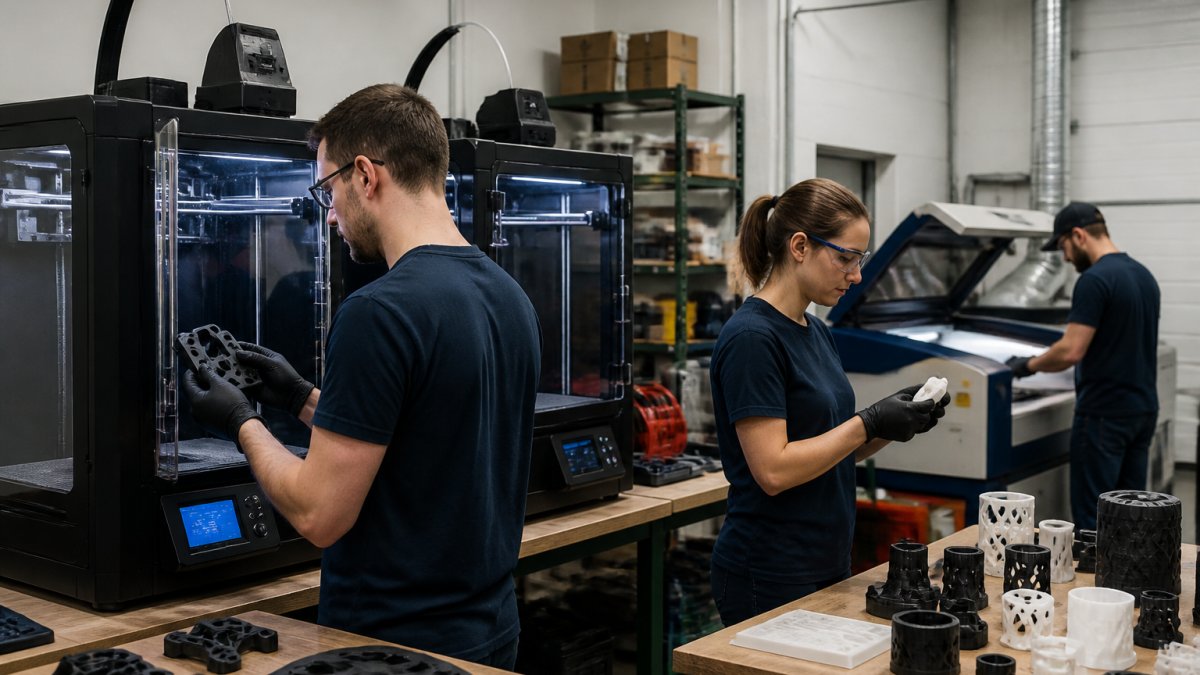
Start by tracking three metrics for each piece of equipment:
- Runtime per week, How many hours is the machine actually running versus sitting idle?
- Setup time, How long does changeover take between batches?
- Throughput per run, How many finished units does one cycle produce?
Many teams discover they're running at 40-60% use. That's misleading: longer batches mean more setup time per unit and higher scrap risk if something goes wrong mid-run.
Document your facility constraints too:
- Floor space for raw materials and finished inventory
- Environmental controls (temperature, humidity) your equipment needs
- Power and compressed air availability
These limits don't change overnight. If your facility is already tight, scaling means new space or tighter inventory cycles, neither is free, and both affect your timeline.
Low-Volume Manufacturing Risks and How to Mitigate Them
The risks of low-volume production become acute when you scale. Understanding them now prevents expensive failures later.
Quality consistency is the first risk.
Supply chain fragility is the second.
Labor scaling is often overlooked. Your team's shortcuts and workarounds must be documented so new hires can execute consistently.
Equipment reliability becomes critical. A printer failure costing one day at small batch sizes costs a week at larger volumes, so shift maintenance from reactive to preventive.
Mitigate these risks by:
- Writing standard operating procedures now, before you scale
- Testing your quality control system at 50% above your current volume
- Qualifying backup suppliers before you need them
Managing Small-Batch Production Costs as You Scale
Unit costs don't drop smoothly with volume, they drop in steps. Find them with a per-unit cost model run at several batch sizes before you commit capital.
Build a batch-size cost model in a spreadsheet
Set up one column per candidate batch size (current run, 1.5x, 2x, 4x) and one row per cost driver, in four blocks:
- Fixed costs per period, equipment depreciation or lease, facility rent, insurance, software, and salaried supervision. These don't change with batch size, so they fall per unit as volume rises, until you need another machine or supervisor.
- Setup and changeover costs, labor hours to clean, fixture, calibrate, and test, plus ramp-up scrap. Setup cost is per run, not per unit, so longer runs spread it thinner, the single biggest lever most small-batch operations have.
- Variable costs per unit, material (including yield loss), direct labor hours times loaded rate, consumables, packaging, and outbound freight. Model material at good-unit cost, not purchased cost, so scrap and rework are captured.
- Working capital, cash tied up in raw material, WIP, and finished goods while a larger batch waits to sell. A batch twice as large ties up roughly twice the cash for the same number of days. Price that at your cost of capital or line of credit rate.
The output you want is fully loaded cost per good unit and cash required at each batch size. A batch size that lowers unit cost but doubles the cash you front is not automatically right.
Where the cost steps actually come from
Per-unit cost falls in discrete steps, each with a nameable cause:
- Setup amortization, the first step down comes from running longer between changeovers. If a changeover takes four hours and a run takes eight, half your machine time is setup; doubling run length nearly halves setup cost per unit with no new equipment.
- Material purchasing tiers, suppliers often price in quantity breaks. Crossing a break can drop material cost per unit meaningfully; staying just under it wastes money. Ask suppliers for their break quantities and price each tier in your model.
- Labor specialization, at low volume one person does everything; at higher volume you can split roles, raising output per labor hour but adding coordination overhead and requiring documented procedures.
A worked comparison (illustrative)
Suppose a run takes 8 hours of machine time plus 4 hours of setup, and setup labor and ramp scrap cost $600 per run. At 100 units, setup is $6.00 per unit; at 200 units it falls to $3.00, a $3.00 saving before material or labor. Make this arithmetic visible for every cost driver at every batch size.
Run the model three ways: base case, a pessimistic case with 25% higher scrap and 10% slower cycle times, and an optimistic case. If the batch size still wins in the pessimistic case, it is probably safe. If it only wins in the optimistic case, it is a bet, not a plan.
Don't forget the costs that scale in jumps
Some costs arrive in chunks: an extra quality inspector, a second shift supervisor, a larger storage lease, a new ERP module, added insurance, and compliance costs tied to higher shipment volumes.
Finally, compare batch sizes on contribution margin per machine hour, not just margin per unit. A batch that earns more per unit but hogs the constraint machine can be worse than a smaller batch that turns the machine faster.
Manufacturing Quality Control Best Practices for Growing Batches
Quality control at small batch sizes is often manual and judgment-based: an experienced team member checks parts and decides if they pass. That works until volume makes checking every unit impossible.
Upload your STL file for an instant quote →
Shift to a documented, repeatable quality control system:
- Define acceptance criteria clearly, Not "looks good" but "dimension A is 10mm ± 0.2mm, dimension B is 5mm ± 0.1mm"
- Establish sampling plans, At what batch sizes do you inspect 100% versus statistical samples?
- Create go/no-go gauges, Simple physical tools that let anyone check parts consistently
- Document failure modes, When parts fail, record why and adjust the process
- Build in process checks, Don't wait until the end. Check intermediate steps
Statistical process control (SPC) becomes valuable at higher volumes: track defect rate over time and stop production when it drifts outside control limits, before you make thousands of bad parts.
Optimizing Small-Batch Production Lead Times and Supply Chain
Lead times grow when you scale because every link stretches at once. The fix isn't negotiating harder on price, it's qualifying your supply base for your target volume before you need it.
Map lead time end to end, then find the longest pole
Build a table with one row per input: supplier, current order quantity, current lead time, lead-time at target volume, MOQ, price break quantities, and single-source flag. Total the critical path, the longest dependent chain, not the sum of every lead time, since many inputs are ordered in parallel.
The longest pole is usually one of three things: a custom or imported component with a long manufacturing lead time, a supplier who manufactures to order rather than stocking, or an inspection/testing step you control. Attack the longest pole first; shaving a week off a short lead time changes nothing.
Qualify suppliers for capacity, not just price
A supplier excellent at your current volume can be wrong at 3x. Ask each critical supplier four questions in writing:
- What is your capacity for this part, and how much of it am I currently using? If you are already a large share of their capacity, you have little room to grow and no leverage if they stumble.
- What are your MOQs and price breaks? MOQs can force you to buy more material than a batch needs, tying up cash and storage. Price breaks tell you where buying slightly more lowers unit cost.
- What is your lead time at my target volume, and what drives it? Distinguish make-to-order from make-to-stock lead times; the former stretches with volume, the latter usually doesn't.
- What is your business continuity plan? Single-site, single-machine, or single-operator suppliers are concentration risk. Ask how they handle equipment failure and key-person absence.
Score each supplier on capacity headroom, lead-time stability, quality history, and financial health. Suppliers who fail on capacity headroom get a backup qualified now, not after a missed shipment.
Build a dual-source and alternate-material plan
For every single-sourced critical input, identify a qualified alternate, a second supplier, a comparable material, or a design variant using an available substitute.
Keep a substitution matrix: for each critical material or component, list the approved alternate, the specification differences, any process adjustments required, and who signs off on the switch. When a shortage hits, the decision is already made.
Manage inventory deliberately, not by gut
Set inventory policy by item class rather than uniformly:
- Long-lead, low-value items, buffer generously; the carrying cost is small relative to the risk of a line-down event.
- Long-lead, high-value items, negotiate supplier-held inventory or scheduled deliveries rather than stocking deeply yourself.
- Short-lead, high-value items, buy close to need; avoid tying up cash.
Calculate a reorder point for each item as average daily usage multiplied by lead time in days, plus a safety stock sized to your acceptable stockout risk. Review the safety stock whenever lead time or usage changes, which is exactly what scaling does.
Reduce lead time inside your own four walls
Supplier lead time is only part of the total. Internally:
- Cut setup time with quick-change fixtures, pre-staged tooling kits, and standardized work instructions so changeovers are repeatable rather than improvised.
- Run smaller, more frequent batches where equipment allows, trading some setup cost for shorter queue times and less work-in-process.
- Separate make-to-stock from make-to-order so long runs don't block short-turnaround orders.
Track the metrics that predict trouble
Watch four numbers weekly: on-time delivery from each critical supplier, lead-time variance (not just average), incoming defect rate, and days of supply on hand for each critical item. Rising lead-time variance is the earliest signal that a supplier is straining before they actually miss a delivery. Act on the trend, not the miss.
Planning Your Pilot Run and Validation Checkpoints
Use these validation checkpoints:
Checkpoint 1: Process Stability, Does your process work consistently at the higher volume? Run three batches back-to-back. Track defect rates, cycle times, and resource usage. If these vary wildly, your process isn't stable yet.
Checkpoint 2: Quality Output, Do finished parts meet specifications? Inspect 100% of pilot run parts.
Checkpoint 3: Cost Reality, Does your actual cost match your projections?
Checkpoint 4: Team Capacity, Can your team execute the process reliably?
Checkpoint 5: Supply Chain Readiness, Can your suppliers deliver at the higher volume?
Document everything from your pilot. Use it to refine your standard operating procedures.
Conclusion
Scaling small batch production isn't just about making more units. It's about redesigning your process, your supply chain, and your team to handle higher volumes reliably. The companies that scale successfully do it deliberately, testing each step before committing.
At Alex 3D Print Us LLC, we help manufacturers navigate this transition with precision. Whether you need rapid prototyping for design validation, custom fabrication for pilot runs, or high-quality parts for scaled production, our turnkey engineering and multi-color 3D printing capabilities support your growth.
Frequently Asked Questions
How do you scale small-batch production without losing quality?
Scaling small-batch production requires three steps: first, validate your process through a pilot run with the larger batch size; second, implement documented standard operating procedures so every operator follows the same steps; third, establish quality checkpoints at critical stages rather than only at the end. Monitor key metrics like scrap rate, yield, and dimensional consistency as batch size increases. Most quality issues arise from inconsistent setup or operator variation, not from the process itself. Start with 20-30% larger batches, measure results, then increase further once you've proven consistency.
What are the biggest risks of low-volume manufacturing?
The primary risks include higher unit costs due to setup time and changeover time spread across fewer parts, longer lead times from suppliers who prioritize larger orders, inconsistent quality if processes aren't fully documented, and difficulty justifying investment in specialized equipment. Additionally, demand forecasting becomes critical but harder with small batches, overestimate and you have excess inventory; underestimate and you face production delays. Supply chain disruptions hit harder when you have no buffer stock. Mitigate these by locking in supplier lead times early, maintaining process documentation, and building a 15-20% demand buffer into your production planning.
How can you reduce small-batch production costs as you grow?
Unit cost drops through three mechanisms: spreading fixed setup costs across more parts, negotiating volume discounts with suppliers as your minimum order quantities increase, and improving machine utilization so equipment runs longer between changeovers. Start by analyzing your current cost breakdown, identify which costs are fixed per batch and which scale with volume. Then prioritize supplier negotiations first (often 10-15% savings available), then optimize your production run length to balance inventory carrying costs against setup time. Consider modular tooling and quick-change fixtures to reduce changeover time, which directly reduces per-unit cost. Document these improvements so they compound as you scale.
How do you estimate lead times for larger production runs?
Lead time has three components: supplier lead time for materials, production time (batch size divided by throughput), and buffer time for quality checks and rework. For small-batch production lead times, start by calculating your actual throughput, parts per hour on your equipment, then divide your new batch size by that number. Add supplier lead time (confirm this in writing; don't assume), then add 10-15% buffer for quality hold and any rework. Example: if your supplier needs 5 days, your machine runs 50 parts per hour, and you're ordering 500 parts, production takes 10 hours (roughly 1-2 days). Total: 5 + 2 + 1 buffer = 8 days. Document actual lead times from each supplier and update your forecasting model as you scale.
