
Custom Industrial 3D Printing Services: 2026 Guide
Table of Contents
- What Custom Industrial 3D Printing Services Deliver
- Top Custom Industrial 3D Printing Services Compared
- Alex 3D Print Us LLC: Turnkey Engineering and Multi-Color Fabrication
- JLC3DP: Multiple Processes at Low Starting Costs
- PCBWay: Low-Volume Production and Rapid Prototyping
- Protolabs: Real-Time Pricing and Material Selection
- Stratasys Direct Manufacturing: Industrial-Scale Solutions
- How to Match a Provider to Your Use Case
- Service Comparison Table
- 3D Printing Materials for Industrial Parts
- 3D Printing Design Guidelines for Manufacturability
- 3D Printing Lead Time: What to Expect
- 3D Printed Parts Quality Inspection Standards
- How to Choose the Right Service for Your Project
- Frequently Asked Questions
Last Updated: October 17, 2026
What Custom Industrial 3D Printing Services Deliver
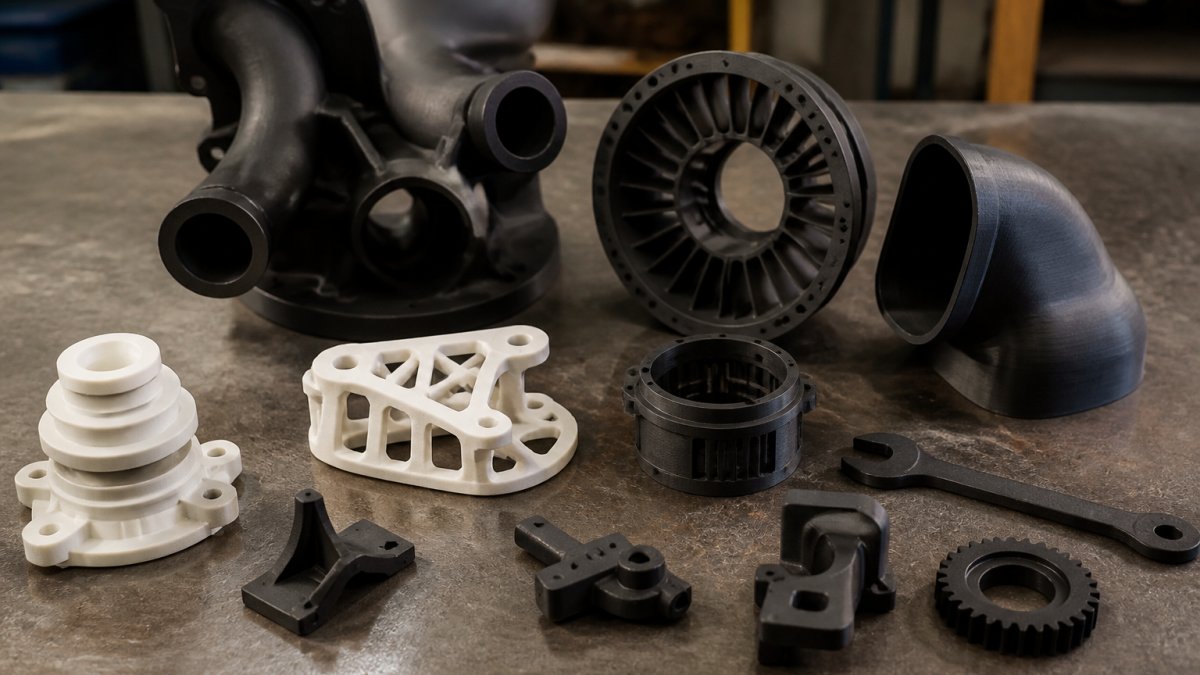
Custom industrial 3D printing services transform digital designs into physical parts on demand.
This suits prototypes, low-volume runs, and specialized components where traditional methods don't make economic sense.
The real value emerges when you need iterations fast: designers test variations without retooling, marketing teams produce branded merchandise without minimum order quantities, and procurement managers source specialized components without inventory commitments.
At Alex 3D Print Us LLC, we combine turnkey engineering, design refinement, and multi-process printing for any project complexity.
Top Custom Industrial 3D Printing Services Compared
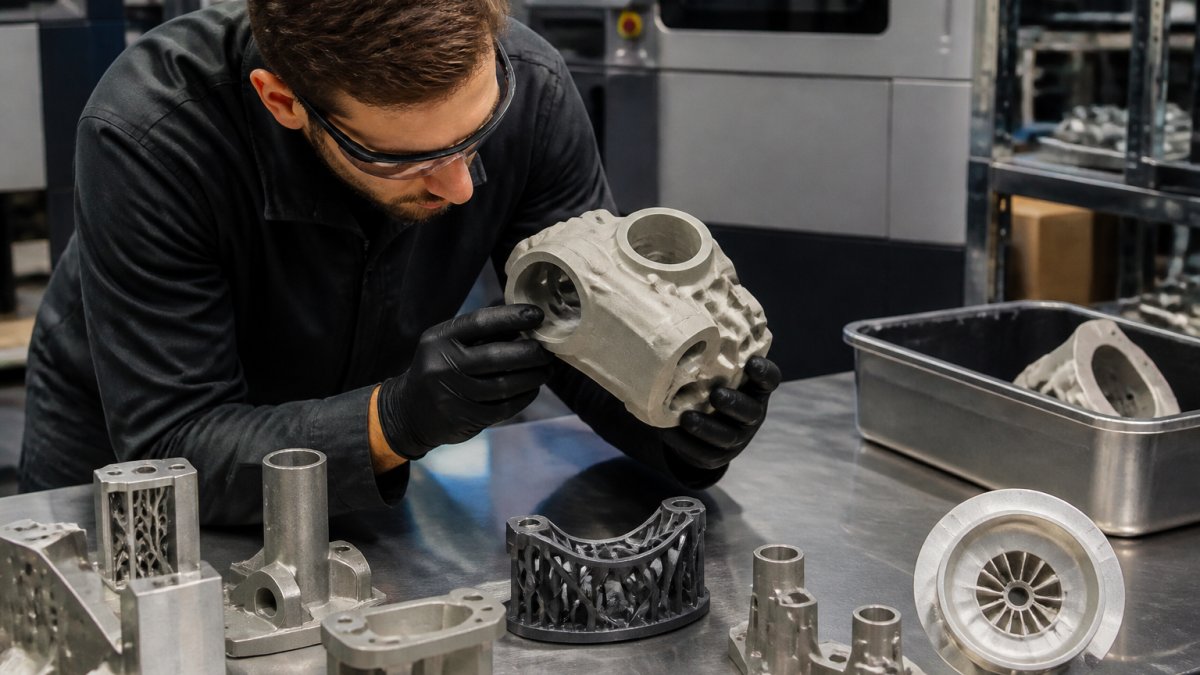
The custom industrial 3D printing landscape includes specialists serving different needs: some excel at speed and affordability, others at precision and industrial-scale production. Rather than ranking providers by marketing claims, match a provider's operating model to your use case: tooling and fixtures, end-use production parts, or prototypes and design iterations.
Alex 3D Print Us LLC: Turnkey Engineering and Multi-Color Fabrication
We handle the full workflow from concept to finished part. Bambu Lab multi-color 3D printing produces branded prototypes and promotional items with embedded color, while xTool UV and MOPA laser engraving add professional finishing for nameplates, trade-show displays, and custom merchandise.
We prioritize fast turnaround without sacrificing quality. Our support team reviews every project before production starts, catching manufacturability issues early, tight tolerances, unsupported overhangs, material limitations.
Best fit: Tooling, fixtures, jigs, branded prototypes, and low-to-mid-volume functional parts where engineering support and multi-color finishing matter more than metal capability.
JLC3DP: Multiple Processes at Low Starting Costs
JLC3DP is a process-agnostic service offering SLA, MJF, SLM, FDM, SLS, and binder jetting from one platform.
The tradeoff: material options and lead times vary significantly by process, so evaluate each independently rather than expecting a single recommendation.
Best fit: Early-stage feasibility testing and process comparison, where the goal is to print the same geometry in several technologies before committing to one.
PCBWay: Low-Volume Production and Rapid Prototyping
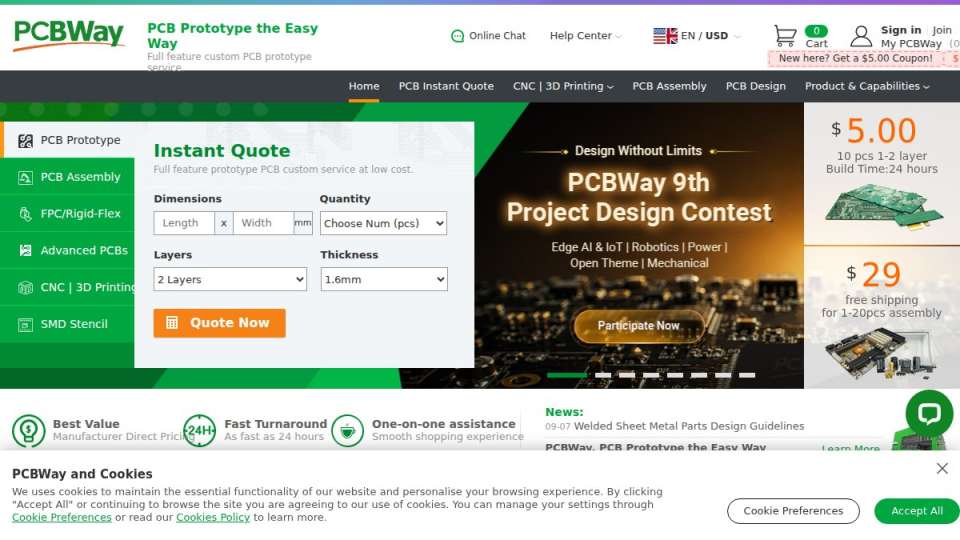
PCBWay targets low-volume production and functional test parts, with FDM, SLA, MJF, SLS, and DMLS covering polymer and metal applications.
The service emphasizes on-demand manufacturing, no minimums, no inventory commitment. This works well for seasonal products, limited-edition items, or iterative development where volumes remain unpredictable.
Best fit: Bridge production and functional test parts in the tens-to-hundreds range, especially when you want polymer and metal options under one account.
Protolabs: Real-Time Pricing and Material Selection
Protolabs' interface prioritizes transparency: upload a design and the system immediately shows pricing, available materials (ABS, PETG, ASA, PEI), and lead time estimates, removing guesswork before you commit.
This helps teams weigh strength, temperature resistance, and chemical compatibility without contacting sales, accelerating decisions for self-service buyers.
Best fit: Design iterations and prototypes where fast, self-service quoting and side-by-side material comparison drive the decision, and where the buyer already has production-ready CAD.
Stratasys Direct Manufacturing: Industrial-Scale Solutions
Stratasys Direct Manufacturing serves organizations scaling beyond prototyping into production. Their industrial 3D printing solutions handle high-volume orders, complex multi-material assemblies, and demanding applications where reliability directly impacts performance, the choice for aerospace, automotive, and medical device makers where failure isn't an option.
The service bureau model means longer lead times, but consistent quality across thousands of parts justifies the wait for production-scale orders.
Best fit: End-use production parts at scale, where batch consistency, material traceability, and industrial-grade process control outweigh speed.
How to Match a Provider to Your Use Case
Start from the use case, not the vendor:
- Tooling, jigs, and fixtures: Prioritize dimensional stability, stiffness, and cost per part over surface finish. FDM and SLS providers with engineering review fit best.
- End-use production parts: Prioritize batch consistency, material traceability, and documented inspection. Industrial service bureaus with production-scale capacity usually fit best, even at longer lead times.
- Prototypes and design iterations: Prioritize speed, low minimums, and quick process or material comparison. Process-agnostic platforms and self-service quoting shorten the loop.
- Branded or customer-facing parts: Prioritize color, finishing, and appearance inspection, since cosmetic defects are the failure mode that matters most.
A practical pattern: run one test part through two or three providers before committing a production order. Comparing quote, lead time, as-built dimensions, and surface finish on the same geometry reveals more than any capability list.
Service Comparison Table
| Service | Best For | Key Strength | Process Options |
|---|---|---|---|
| Alex 3D Print Us LLC | Turnkey projects, branded merchandise, trade-show pieces | Engineering support + multi-color printing | FDM, laser engraving |
| JLC3DP | Cost-conscious teams comparing processes | Low starting price, process flexibility | FDM, SLA, SLS, MJF, SLM, binder jetting |
| PCBWay | Low-volume production runs, functional parts | On-demand manufacturing, no minimums | FDM, SLA, SLS, MJF, DMLS |
| Protolabs | Transparent pricing, material selection | Real-time quotes, online self-service | FDM, SLA, SLS, and others |
| Stratasys Direct | Production-scale manufacturing, high reliability | Industrial capability, quality consistency | Multiple industrial processes |
3D Printing Materials for Industrial Parts
Selecting the right material determines whether your part performs. Different processes produce different material properties, and industrial applications demand specific performance characteristics.
SLA resins deliver precision and surface finish for detailed parts but lower mechanical strength than thermoplastics, excelling for visual prototypes, intricate assemblies, and parts where dimensional accuracy matters more than load capacity.
SLM and DMLS metal printing produces titanium, aluminum, and stainless steel components for aerospace, medical, and high-temperature applications, commanding premium pricing but enabling designs impossible through traditional machining.
Upload your STL file for an instant quote →
3D Printing Design Guidelines for Manufacturability
Your CAD file determines whether your part prints successfully or fails mid-production. A few principles prevent costly mistakes.
Wall thickness matters.
Overhangs and unsupported geometry require support structures that waste material and leave surface marks.
Dimensional tolerances should reflect process capabilities: FDM typically holds ±0.2mm on critical dimensions, SLA improves to ±0.1mm, and SLM achieves ±0.05mm at significantly higher cost.
3D Printing Lead Time: What to Expect
Lead time depends on queue length, part complexity, and post-processing. Most on-demand services quote 3-7 business days from order to shipment for standard materials and straightforward geometry.
Rush options compress this to 1-2 days but add 20-40% to part cost.
Post-processing extends lead time: removing supports, sanding, and curing resin parts adds 2-5 days depending on part count and complexity; painting, plating, or functional testing add further delays.
3D Printed Parts Quality Inspection Standards
Quality assurance in 3D printing focuses on dimensional accuracy, material properties, and surface finish. The useful question isn't whether a service inspects parts, but which methods it uses, what it records, and whether that record travels with the parts.
Dimensional Verification
Dimensional inspection confirms the as-built part matches the CAD model within tolerance. Common methods, from lightest to most rigorous:
- Calipers and micrometers on critical features for straightforward parts.
- Coordinate measuring machines (CMM) for complex geometry and tight tolerances, producing a documented dimensional report.
- Optical and structured-light scanning for full-surface comparison against the CAD model, useful for freeform geometry and for visualizing deviation across the whole part rather than at sampled points.
A common pattern is first-article inspection on the initial part, followed by sampling on subsequent parts. Ask whether inspection happens on every part, a sample, or only on request, since that distinction drives both cost and confidence in a batch.
Material and Mechanical Verification
A part can print dimensionally perfect and still fail under load if the material was improperly processed, such as under-cured resin or moisture-laden filament. Tensile, hardness, and impact testing validate properties for load-bearing components: hardness is a fast check on cure and consistency for polymers, while density and porosity checks matter more for metal parts.
Traceability and Documentation
Traceability separates a production-grade inspection program from a cosmetic check. A documented record ties a batch to its material lot, build parameters, inspection results, and the operator who signed off, which is the evidence regulated industries need. Ask what ships with the parts: a dimensional report, a material certificate, and a build record are the baseline for production work.
Standards and Quality Systems
According to ASME standards for additive manufacturing, industrial parts should undergo documented inspection protocols that verify dimensional accuracy, material composition, and functional performance. The relevant framework for most buyers is a combination of:
- Additive manufacturing standards from ASME and ASTM International that define terminology, test methods, and qualification practices for AM processes.
- ISO 9001 quality management systems, which indicate a provider has documented processes for handling nonconformities, corrective actions, and records.
- Industry-specific requirements for aerospace, medical, and automotive work, which layer additional qualification and traceability demands on top of the general standards.
Services serving aerospace and medical markets follow these standards rigorously, while consumer-focused services may offer lighter inspection as a cost-saving option, fine for visual prototypes but not for load-bearing or regulated parts.
How to Choose the Right Service for Your Project
Start by defining your requirements: material, quantity, deadline, and budget per part. These narrow the field dramatically.
Material selection often determines your vendor: multi-color printing for branded merchandise points to Bambu Lab-equipped services, metal components require SLM or DMLS.
The NIST guide to additive manufacturing process selection outlines a systematic approach to matching processes to application requirements.
Request sample quotes on a test part before committing to production.
Choosing the right custom industrial 3D printing service depends on your project needs, timeline, and budget. Upload your design today and see how we can accelerate your product development.
Frequently Asked Questions
What can custom industrial 3D printing services be used for?
Custom industrial 3D printing services produce functional prototypes, low-volume production parts, replacement components, tooling, and custom fixtures. Industries use them for rapid product iteration, on-demand manufacturing when traditional methods are uneconomical, and specialized parts that would require expensive molds or setup. Startups, manufacturers, and design teams rely on these services to move from CAD file to finished part in days rather than weeks.
How do I know which 3D printing materials work for industrial parts?
Material selection depends on your part's function. FDM thermoplastics like ABS and PETG suit mechanical prototypes and wear-resistant applications. SLA resins offer precision for detailed parts. Nylon powders from SLS and MJF provide strength and flexibility for functional components. Industrial metals from SLM suit high-temperature or load-bearing parts. Discuss your performance requirements, strength, temperature range, chemical resistance, with your service provider to match the material to your use case.
How long does a custom 3D printing lead time typically take?
Lead times vary by service and complexity. Many online services offer quotes within hours of file upload and can print within 3-5 business days for standard parts. Rush services may compress this to 24-48 hours at higher cost. Post-processing, curing, and inspection add 1-3 days. For production runs or parts requiring custom fixtures, expect 1-2 weeks. Always confirm lead time during quoting to ensure it matches your project deadline.
What quality checks should custom 3D-printed industrial parts pass?
Reputable services perform dimensional inspection using calipers or CMM machines to verify tolerances. Visual inspection checks for surface defects, layer consistency, and proper support removal. Functional testing confirms the part meets performance specs. Some services offer certified inspection reports. Request specific quality standards upfront, tolerance requirements, material certifications, or test documentation, so the service can plan accordingly and deliver parts that pass your acceptance criteria.
Why choose an online 3D printing service over in-house printing?
Online services eliminate capital investment in equipment, eliminate operator training, and offer access to multiple printing processes and materials from one platform. They handle post-processing, quality control, and delivery. For startups and small manufacturers, this reduces overhead and accelerates time-to-market. Services with turnkey engineering support also help optimize designs for additive manufacturing, catching manufacturability issues before printing begins.