
Rapid Prototyping for Product Development: A 2026 Guide
Table of Contents
- What Rapid Prototyping Is and How It Fits Into Product Development
- Rapid Prototyping Process Steps and Workflow Integration
- Rapid Prototyping Methods and Technology Options
- Prototype Testing and Validation Strategies
- Key Benefits of Rapid Prototyping in Product Development
- Common Pitfalls and When Rapid Prototyping Is Not Enough
- Selecting a Rapid Prototyping Partner for Your Product Development
- Frequently Asked Questions
Last Updated: October 14, 2026
What Rapid Prototyping Is and How It Fits Into Product Development
Rapid prototyping for product development cycles means quickly creating physical models from digital designs to test concepts, validate functionality, and refine products before full-scale manufacturing. Where traditional development takes months to reach a testable model, rapid prototyping produces working prototypes in days or weeks.
The Role of Physical Models in Concept Validation
A physical prototype reveals what digital models cannot: assembly issues, weight distribution, ergonomics, and material feel only become apparent in the physical world.
This is where rapid prototyping product development becomes essential to risk reduction. Early physical validation catches problems while changes are inexpensive: redesigning a prototype costs hundreds or thousands of dollars, while redesigning after tooling and production setup costs hundreds of thousands.
How Rapid Prototyping Shortens Development Cycles
Traditional product development moves through rigid phases, concept, detailed design, tooling, production setup, manufacturing, each taking weeks or months.
The acceleration compounds with fast iteration. Instead of one prototype per quarter, teams using rapid prototyping product development methods often produce three to five iterations per month. Products that would take 12-18 months traditionally reach market in 6-9 months.
Rapid Prototyping Process Steps and Workflow Integration
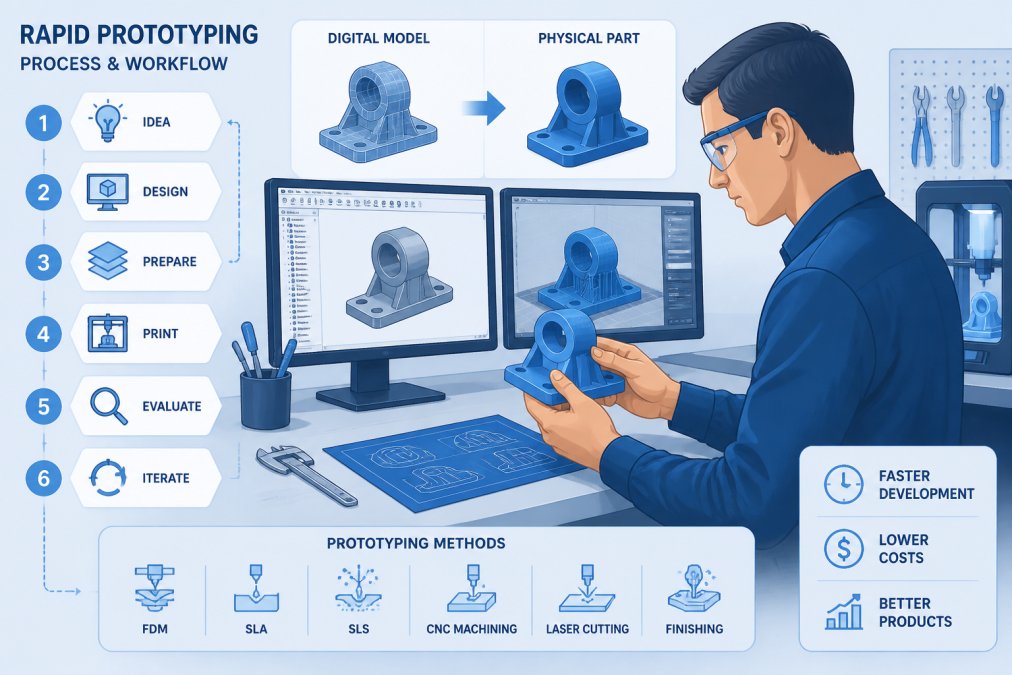
The process breaks into three stages, each with specific deliverables and decision points, so you can integrate rapid prototyping into your existing cycle.
Stage 1: Digital Design and CAD Preparation
Your design must exist in a format fabrication equipment can interpret: CAD files, either 3D models (STEP, IGES, STL) or 2D drawings for laser engraving and CNC work.
This stage is where many teams stumble. A CAD file that looks correct on screen may contain geometry fabrication equipment cannot produce: walls too thin, unsupported overhangs, tolerances tighter than the method can achieve.
Stage 2: Method Selection and Fabrication
Once your design is CAD-ready, choose the fabrication method based on your prototype's purpose, timeline, and budget, the method also determines material options, surface finish, and achievable tolerances.
The fabrication itself is where the speed advantage becomes tangible. A 3D-printed prototype can be completed in 24-48 hours. CNC machining typically takes 3-7 days depending on complexity.
Stage 3: Assembly, Post-Processing, and Delivery
Raw fabricated parts rarely arrive production-ready. 3D-printed parts may need support material removed, sanding, or edge finishing; CNC-machined parts may require deburring or coating; multi-part assemblies must be fitted and function-tested.
This stage also includes quality verification: does the prototype meet the acceptance criteria defined before fabrication, assemble correctly, and match your finish intent?
Rapid Prototyping Methods and Technology Options
The fabrication method determines what's possible in your prototype and how quickly you can produce it. Each has strengths, limitations, and ideal use cases.
3D Printing and Additive Manufacturing
3D printing builds parts layer by layer from digital files, adding rather than removing material.
3D printing works best for visual prototypes, proof-of-concept models, and functional prototypes where plastic properties are acceptable; it struggles with parts needing high strength, tight tolerances, or metal properties.
CNC Machining and Subtractive Fabrication
CNC machining removes material from solid blocks using rotating cutting tools, producing excellent dimensional accuracy and surface finish.
Machining is slower than 3D printing, a simple part takes 3-5 days, complex parts longer, but the precision and material options often make the time worthwhile.
Choosing the Right Method for Your Design
The choice depends on what your prototype must prove, what material properties matter, and your timeline.
Choose 3D printing to validate form factor, ergonomics, or assembly fit, to iterate quickly, or when the prototype will be handled, photographed, or presented to stakeholders.
Prototype Testing and Validation Strategies
A prototype's value depends on what you learn from it. Testing and validation turn fabricated parts into actionable design data.
Functional Testing and Performance Measurement
Functional testing answers whether the design works as intended, with tests depending on your product: a mechanical assembly for range of motion, force, and durability; an electronic enclosure for thermal management or ingress protection; a consumer product for drop impact or material degradation.
Define acceptance criteria before fabrication: the exact tests, conditions, and pass/fail thresholds. This prevents subjective evaluation and ensures each iteration moves closer to a manufacturable design. Document results in a test report that becomes part of your development record.
User Feedback and Design Refinement
Functional testing validates that your design works; user feedback validates that it works for the people who will use it.
User feedback often reveals issues engineering analysis misses: a control obvious to the designer may confuse users, an essential feature may go unused, a material that looks good may feel wrong in hand. This drives refinement cycles that improve the final product.
Acceptance Criteria and Production Readiness
As prototypes approach production, acceptance criteria tighten: the prototype must function correctly and demonstrate manufacturability at scale, including dimensional accuracy matching production tolerances, surface finish consistency, and material properties matching specification.
Production readiness also means validating that your fabrication partner can produce the part reliably at volume, a prototype that works as a one-off may fail in batches of 1,000.
Key Benefits of Rapid Prototyping in Product Development
Rapid prototyping for product development cycles delivers measurable advantages that compound throughout development.
Accelerated Time to Market and Reduced Risk
The primary benefit is speed. Compressing months of development into weeks gets your product to market faster, which translates directly to competitive advantage: you capture market share before competitors, respond to customer feedback before the market shifts, and validate product-market fit with real users rather than assumptions.
Upload your STL file for an instant quote →
Speed also reduces risk: early validation catches design flaws before they become expensive, you test assumptions with prototypes rather than committing to full production, and you can pivot on user feedback without massive sunk costs.
Cost Reduction Through Early Design Validation
Rapid prototyping seems expensive per unit, a single run might cost several hundred dollars, but that is trivial next to discovering a design flaw after tooling and production setup.
Early validation also cuts total development cost by eliminating wasteful cycles: instead of five prototypes to find the right design, you might build three.
Improved Design Quality and Manufacturability
Prototypes force you to consider manufacturing constraints early.
These discoveries lead to better designs: you refine for manufacturability, optimize for production efficiency, and build in robustness to manufacturing variation. The result is a product that works better and costs less to manufacture.
Common Pitfalls and When Rapid Prototyping Is Not Enough
Rapid prototyping is powerful but not universal. Understanding its limitations prevents wasted effort and unrealistic expectations.
Prototype-to-Production Gaps
A prototype that works perfectly in small quantities may fail in production, the prototype-to-production gap is where many projects encounter problems.
Bridging this gap requires deliberate planning: apply design-for-manufacturability principles early, anticipate production constraints in prototype designs, run process capability studies to confirm equipment can achieve required tolerances, and pilot production runs before full manufacturing commitment.
Material and Manufacturing Constraint Mismatches
A prototype material might not match the production material: a 3D-printed plastic prototype behaves differently than an injection-molded part from the same resin, and a CNC-machined aluminum prototype differs from a die-cast production part.
When material properties affect performance, test prototypes made from production materials, otherwise results may not predict production performance.
Regulatory and Safety Compliance Considerations
Prototypes don't need to meet regulatory requirements; production parts do. A prototype might pass internal testing but fail regulatory testing.
Understand your regulatory landscape early: identify the standards and certifications your product must meet, design prototypes testable against them, and validate your approach before committing to production.
Selecting a Rapid Prototyping Partner for Your Product Development
Your rapid prototyping partner becomes an extension of your engineering team, so choosing well accelerates development and improves results.
Evaluating Capabilities and Technology
Assess whether a partner has the capabilities your project requires: 3D printing, CNC machining, laser engraving, multi-material printing, your material and tolerance requirements, and experience in your product category.
Technology matters, but a partner with older equipment and deep industry expertise may outperform one with modern equipment and no relevant experience. Ask about turnaround times, quality control, and design-for-manufacturability approach, and request references.
Alex 3D Print Us LLC brings comprehensive capabilities including Bambu Lab multi-color 3D printing, xTool UV and MOPA laser engraving, and turnkey engineering and design services.
Turnaround Time and Scalability Expectations
Rapid prototyping is only rapid if your partner delivers quickly.
Also understand their scalability: a partner great at one-off prototypes might struggle with 50 units for user testing or 500 for a pilot run.
Rapid prototyping for product development cycles has become essential to competitive product development.
At Alex 3D Print Us LLC, we support product development projects from prototype through production.
Frequently Asked Questions
How does rapid prototyping fit into the product development cycle?
Rapid prototyping transforms the product development cycle by compressing design validation into weeks rather than months. You move from CAD models to physical prototypes quickly, test real-world performance, gather user feedback, and refine designs iteratively. This front-loads risk reduction and manufacturability checks before committing to production tooling, which typically represents the largest cost and longest lead time in traditional development.
What rapid prototyping methods work best for different design stages?
Early concept validation uses 3D printing for speed and visual prototypes; mid-stage design refinement often combines 3D printing with CNC machining for functional testing of specific components; late-stage pre-production uses CNC or injection molding trials to confirm manufacturing constraints. The choice depends on material requirements, tolerance precision, and whether you're testing form, fit, or function. A prototyping partner can advise which method matches your current development phase.
How many prototype iterations typically occur before production?
Most product development requires 3-5 meaningful iterations, though complex assemblies may need more. Each iteration tests specific hypotheses: Does it fit? Does it function? Does it meet user expectations? Can it be manufactured at scale? The goal is to resolve design unknowns before production tooling is ordered, which is why rapid prototyping reduces both development time and total project cost significantly.
What should you test with a product prototype?
Functional prototypes validate performance metrics: stress, thermal behavior, electrical function, assembly feasibility. Visual prototypes confirm ergonomics, aesthetics, and user interface logic. User feedback prototypes test real-world usability and identify design flaws early. Manufacturability prototypes ensure the design can actually be produced at scale without excessive cost or complexity. A structured testing plan with measurable acceptance criteria prevents iteration loops that waste time and money.
What makes rapid prototyping different from traditional prototype development?
Traditional prototyping relied on hand-built models or limited tooling, taking weeks or months per cycle. Rapid prototyping uses 3D printing, CNC machining, and digital design to compress cycles to days, enabling multiple design-test-refine loops within the same timeline traditional methods allowed for one. This speed advantage compounds: more iterations mean better designs and lower production risk.
How do you know if a rapid prototyping service can handle your project complexity?
Ask whether they offer turnkey engineering support, handle multi-material designs, provide post-processing (painting, assembly, laser engraving), and work with your file formats. Confirm they've delivered similar complexity before, ask for examples, and verify they can manage tight tolerances if your design requires them. A service offering instant quotes and design feedback early signals they have the infrastructure and expertise to handle complex projects without surprises.
What are the main limitations of rapid prototyping?
Rapid prototyping excels at design validation but cannot always replicate final production materials or processes at scale. Some 3D-printed materials have limited durability or environmental resistance. Tight tolerances may require CNC finishing, adding cost and time. Very high-volume production eventually shifts to injection molding or other mass-production methods. Regulatory testing (for medical, aerospace, or safety-critical applications) may require additional validation beyond prototyping. Understanding these limits prevents overreliance on prototype performance as a guarantee of production success.