
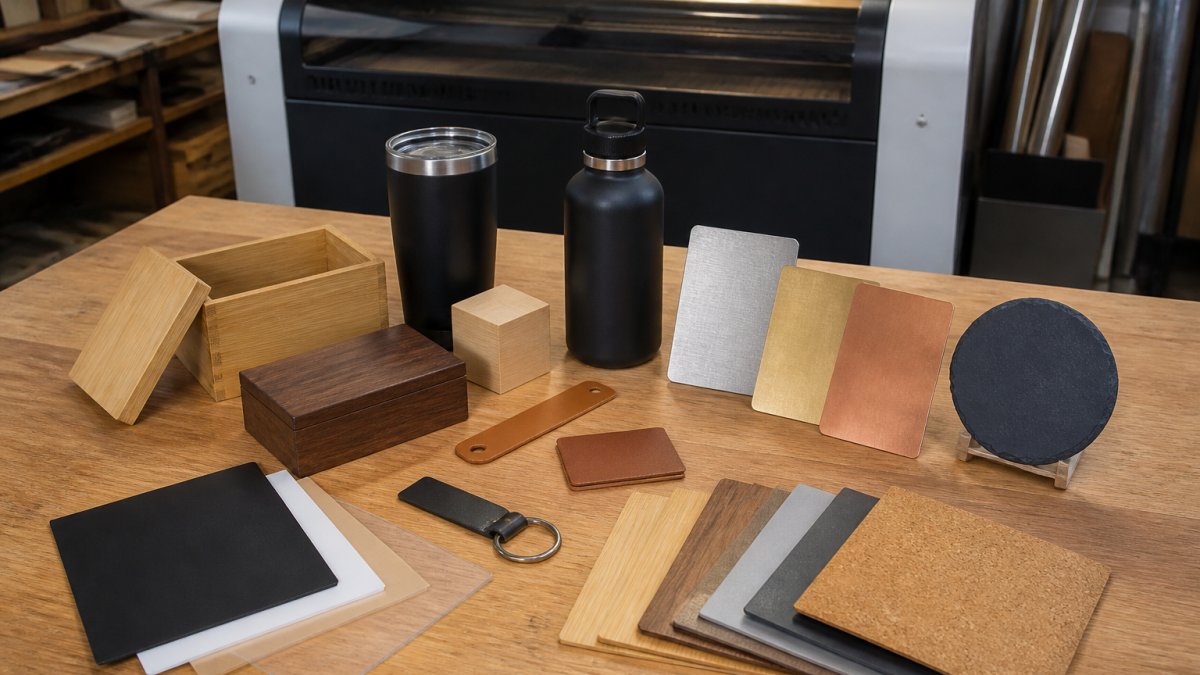
How to Select Materials for Laser Engraved Merchandise
Last Updated: October 23, 2026
Quick Summary
To select materials for laser engraved merchandise, match each substrate's composition, density, and surface finish to your laser type and the product's end use. Hardwoods, anodized aluminum, stainless steel, glass, and leather hold permanent marks, while PVC, vinyl, and ABS plastic should be avoided. Always test-engrave a scrap piece from the same batch before production.
- PVC and vinyl release chlorine gas when engraved, damaging optics and posing a health risk.
- Maple gives the sharpest contrast for logos, while walnut suits premium dark-toned gifts.
- Cotton and canvas engrave well, but polyester and nylon melt into shiny beads.
- Pair drinkware with anodized aluminum or stainless steel, and awards with maple, walnut, or glass.
- Confirm the exact material grade and check the safety data sheet before ordering.
Table of Contents
- Start With the Substrate: What Decides Engraving Quality
- Best Materials for Laser Engraving Promotional Items
- Laser Engraving Material Compatibility: What Works and What Fails
- Laser Engraving Wood: Species, Grain, and Finish Choices
- Laser Engraving Fabric: Apparel and Textile Merchandise
- Match the Material to the Merchandise Type
- Material Selection Checklist Before You Order
- Conclusion
- Frequently Asked Questions
Start With the Substrate: What Decides Engraving Quality
The material you choose decides almost everything about how laser engraved merchandise turns out. Material selection for laser engraved merchandise is the process of matching a substrate's composition, density, and surface finish to the laser type and the product's end use. Get that match right, and you get crisp, permanent marks. Get it wrong, and you get melting, charring, or a logo that fades in a month.
At Alex 3D Print Us LLC, we run MOPA laser engraving and UV printing daily, and the same rule holds every time: the substrate sets the ceiling on quality before the laser ever fires.
Here's what actually matters:
- Composition: wood, metal, glass, and leather react differently to the same beam.
- Density and grain: tight grain holds fine detail; loose grain blurs it.
- Surface coating: paint, varnish, and anodizing change how the mark appears.
- End use: a keychain and a water bottle face very different wear.
Below, we'll show you exactly how to match each material to the job, plus the ones to keep off the bed entirely.
Best Materials for Laser Engraving Promotional Items
The best materials for laser engraving are hardwoods, anodized aluminum, stainless steel, glass, and leather. Each holds a permanent mark, tolerates handling, and looks professional in a client's hands. Soft plastics and untreated mild steel are the usual weak spots.
For a full breakdown of product options, see our guide to custom laser engraved promotional items. It covers which items work best for giveaways, client gifts, and event swag.
A quick note on why these five win: they either vaporize cleanly or change color at the surface without warping. That means no post-processing, no peeling, and no rework.
Laser Engraving Material Compatibility: What Works and What Fails
Laser engraving material compatibility comes down to one question: does the material absorb the beam's energy in a controlled way? Materials that vaporize cleanly or change color at the surface engrave well. Materials that melt, reflect, or release fumes do not.
The table below is the fastest way to sort a material before you commit.
| Material | Engraves Well? | Watch Out For | Best Use |
|---|---|---|---|
| Hardwood (maple, walnut) | Yes | Grain variation | Plaques, coasters |
| Anodized aluminum | Yes | Thin coatings | Bottles, tags |
| Stainless steel | Yes (fiber/MOPA) | High reflectivity | Tumblers, tools |
| Glass | Yes | Micro-fracture risk | Awards, drinkware |
| Leather | Yes | Fume smell | Wallets, patches |
| Natural fabric | Yes | Scorching | Totes, aprons |
| ABS plastic | Poor | Melting, fumes | Avoid |
| PVC | Never | Toxic chlorine gas | Never |
If you're still weighing engraving against other branding methods, our comparison of 3D printing vs laser engraving for branding explains where each one wins.
Materials That Should Never Go Near the Laser
PVC and vinyl release chlorine gas when cut or engraved. That gas corrodes the machine's optics and metal parts, and it is a genuine health hazard. Polycarbonate and most styrene plastics melt into a gummy mess instead of vaporizing. Keep them off the bed.
Laser Engraving Wood: Species, Grain, and Finish Choices
Laser engraving wood works best on tight-grained hardwoods like maple, walnut, cherry, and birch plywood. These species hold fine detail and produce a clean, high-contrast mark. Softwoods like pine engrave unevenly because their grain density varies, so the beam cuts deeper in some bands than others.
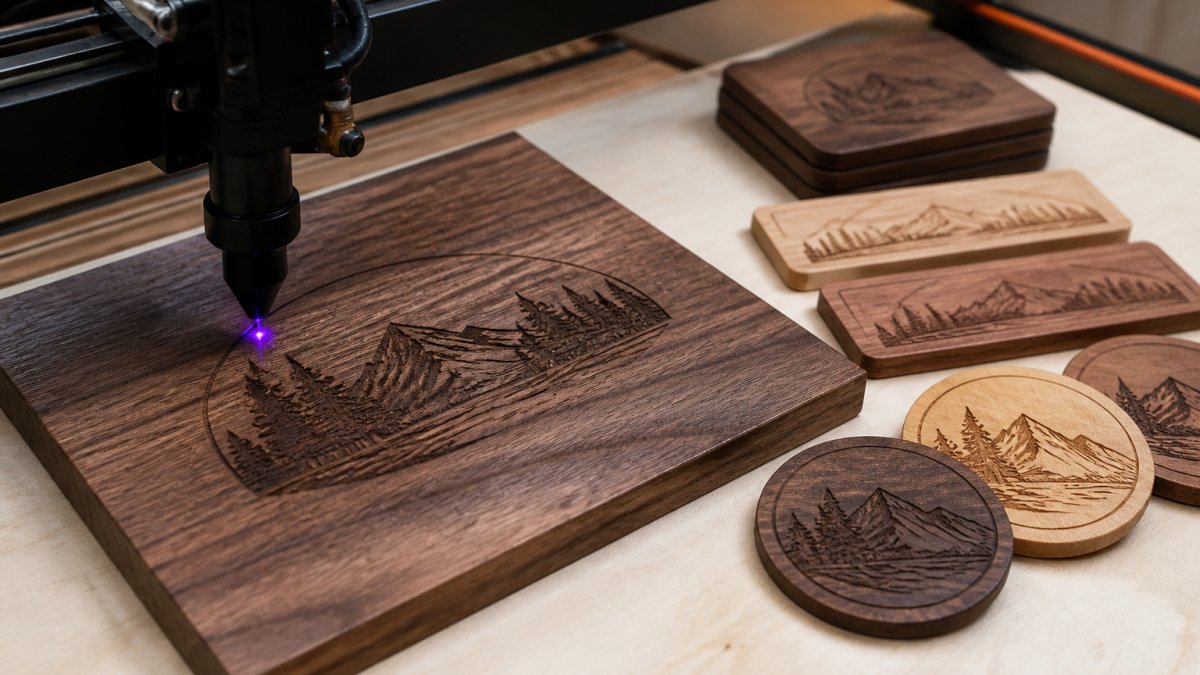
A few rules we follow in the shop:
- Maple gives the sharpest contrast for logos and text.
- Walnut offers rich, dark tones that suit premium gifts.
- Cherry darkens naturally over time, which can shift the look of a mark.
- Plywood is affordable but can show glue lines in the engraved area.
Finish matters too. A light sanding before engraving removes surface oils that cause uneven burns. Seal the piece afterward with a clear coat to protect the mark from handling.
Upload your STL file for an instant quote →
Laser Engraving Fabric: Apparel and Textile Merchandise
Laser engraving fabric works on natural fibers like cotton, canvas, denim, and leather. The beam burns away surface fibers to create a permanent, faded mark. Synthetics are a different story. Polyester and nylon melt into hard, shiny beads instead of producing a clean etch.
For event apparel with tight deadlines, our guide to trade show promotional items with fast turnaround covers which fabric items move quickest.
Natural Fibers vs. Synthetics on the Bed
Cotton and canvas take a mark well because plant fibers scorch predictably. Wool and felt work too, though they carry a burnt smell that lingers. Synthetics fail for a simple reason: they're plastic. The beam melts them rather than burning them away, which leaves a raised, glossy scar.
Test on a scrap piece first. Fabric weight and weave change how deep the beam penetrates, and a setting that works on a heavy canvas tote will burn straight through a thin t-shirt.
Match the Material to the Merchandise Type
Matching material to product type prevents most rework. A drink tumbler needs a metal that survives dishwashers. A tote bag needs a fabric that won't fray at the mark. An award plaque needs a wood that holds fine text at small sizes.
Here's how we'd pair them:
- Drinkware: anodized aluminum or stainless steel
- Awards and plaques: maple, walnut, or glass
- Apparel and totes: cotton canvas or leather patches
- Keychains and tags: anodized aluminum or hardwood
- Signage: acrylic, hardwood, or coated metal
Once you've matched materials to products, you can review our laser engraving, glass etching, and UV printing services to see how each finish is produced.
Material Selection Checklist Before You Order
Run this checklist before you send a single file. It catches the mistakes that cause rework, missed deadlines, and wasted stock.
- Confirm the exact material and grade, not just "metal" or "wood"
- Check the material safety data sheet for PVC or chlorine content
- Test-engrave a scrap piece at your planned settings
- Match the material to how the item will be used and cleaned
- Confirm thickness and size fit your product spec
- Verify the mark will stay legible at the final scale
- Order a small sample batch before a full production run
- Allow lead time for finishing, sealing, or assembly
When you're ready to move, you can upload your file for an instant quote and get pricing based on your material, quantity, and deadline.
Conclusion
The hardest part of laser engraved merchandise isn't the design. It's picking a substrate that holds the mark, survives real use, and fits your budget and timeline. Most failed jobs trace back to a material mismatch, not a bad file.
Alex 3D Print Us LLC handles that match for you, with MOPA laser engraving, xTool UV printing, and Bambu Lab multi-color 3D printing under one roof. We support projects of any complexity and turn them around fast, so your branded items arrive ready for the show floor or the client's desk.
Get started with Alex 3D Print Us LLC and upload your STL file for an instant quote today.
Frequently Asked Questions
What materials can be laser engraved for promotional products?
Wood, leather, glass, coated metals, acrylic, natural fabrics like cotton and canvas, and anodized aluminum all engrave well. Each reacts differently: wood chars to a dark brown, coated metal reveals the bare layer beneath, and glass etches to a frosted white. Uncoated bare metals and most clear plastics resist standard CO2 engraving, so confirm the substrate and the laser type before committing to a large order of laser engraved merchandise.
What materials should never be laser engraved?
Polyvinyl chloride (PVC) releases chlorine gas that corrodes laser optics and poses a health hazard, so it is off the table. Polystyrene and polycarbonate melt and discolor rather than engrave cleanly. Fiberglass and carbon fiber can produce hazardous fumes. Any material with an unknown coating should be tested first, because some finishes contain compounds that burn unpredictably and ruin both the part and the batch.
How do you test a material before engraving a large order?
Request a physical sample or send a scrap piece of the exact substrate, coating, and color you plan to use. Engrave a small version of your artwork at two or three power and speed settings, then check contrast, depth, and edge sharpness. Test washing or handling durability if the item is apparel. Approve the sample in writing before the full run, since a different dye lot or finish batch can change how the material responds.
How does material affect laser engraving quality?
Density, grain, coating thickness, and moisture content all change the result. Tight-grained hardwoods hold fine detail; open-grained softwoods blur small text. Coated metals give crisp contrast only if the coating is uniform. Fabric engraving depends on fiber content, with cotton charring predictably while synthetics melt. Choosing the right substrate up front matters more than tweaking settings afterward, which is why material selection drives the whole project.
