
Is Laser Engraving Permanent on Aluminum? What Lasts
Last Updated: November 4, 2026
Quick Summary
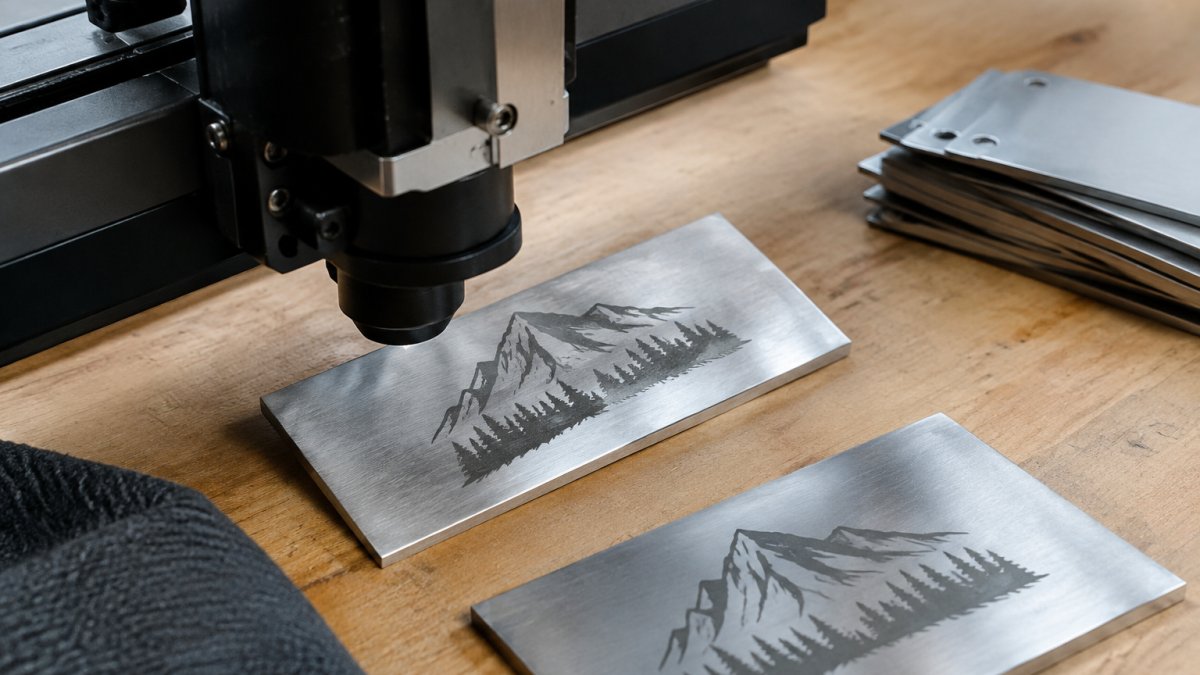
Yes, laser engraving permanent results on aluminum come when the laser removes or restructures the metal itself rather than sitting on top of it. Engraving cuts a cavity into the metal, so abrasion must wear down the surrounding surface before it reaches the mark. Surface marking only changes color and can wear away under heavy abrasion.
- Engraving removes material and cuts a visible cavity into the aluminum, while surface marking only changes color.
- Bare aluminum usually calls for a fiber laser because it reflects and conducts heat away fast.
- Anodized aluminum is the most reliable finish for high-contrast marks with diode or fiber lasers.
- Build a three-by-three test grid on scrap from the same batch before marking a production part.
- Run a rub test with an abrasive pad for 30 seconds: surface marks fade, engraved marks hold.
Table of Contents
- What Actually Makes a Laser Mark on Aluminum Permanent
- Engraving Versus Surface Marking: Two Different Outcomes
- Bare, Anodized, and Coated Aluminum: How Each Finish Reacts
- Laser Engraving Aluminum Settings That Hold Up
- Engraving Aluminum With a Diode Laser: Realistic Limits
- Anodized Aluminum Laser Engraving: Why Contrast Lasts
- When You Need a Fiber Laser Engraver for Aluminum
- How to Test Whether Your Mark Is Truly Permanent
- Frequently Asked Questions
What Actually Makes a Laser Mark on Aluminum Permanent
Is laser engraving permanent on aluminum?
The difference between a mark that lasts and one that fades comes down to one thing: depth and structure.
Two mechanisms create a lasting mark:
- Material removal: the beam vaporizes aluminum, cutting a shallow cavity into the surface.
- Surface oxidation: the beam heats the metal, changing its color without cutting into it.
Both are permanent in the everyday sense. Neither rubs off, because there is nothing applied to rub off. A sticker peels.
The catch is that "permanent" depends on the process. A mark that only discolors the surface can still wear away under heavy abrasion.
Engraving Versus Surface Marking: Two Different Outcomes
Engraving generally offers stronger durability. The mark sits below the original surface, so abrasion has to wear down the surrounding metal before it touches the mark.
Surface marking is faster and often higher contrast. On anodized aluminum, the beam can turn the coating white or dark without cutting through it.
| Feature | Laser Engraving | Surface Marking |
|---|---|---|
| What happens | Material removed | Surface color change |
| Depth | Cut into metal | Near-surface only |
| Abrasion resistance | High | Moderate |
| Contrast | Good on bare metal | High on anodized |
| Best for | Serial numbers, deep logos | Decorative contrast |
A common mistake is assuming every dark mark is engraved. Many are not.
Bare, Anodized, and Coated Aluminum: How Each Finish Reacts
Finish decides how a mark forms, and it decides how long that mark lasts.
Bare aluminum is reflective and conducts heat away fast.
Anodized aluminum carries a thin oxide layer that absorbs laser energy well. The beam disrupts that layer, producing white or dark contrast.
Coated aluminum has paint or powder coat on top. The laser can remove the coating to expose bare metal underneath, creating contrast by subtraction.
Use this decision framework before you commit a file to a machine:
| Finish | Best laser type | Typical mark | Durability profile | Watch out for |
|---|---|---|---|---|
| Bare aluminum | Fiber | Light gray to frosted, or deep cavity | High when engraved; low when surface-marked | Diode lasers may not mark at all without spray |
| Anodized aluminum | Diode or fiber | White or dark contrast in the oxide layer | Moderate to high; fails only if the oxide is cut through | Overpowering can crack or craze the oxide around the mark |
| Painted or powder coated | Diode or fiber | Coating removed to expose bare metal | Depends on coating adhesion; can chip at edges | Wrong power burns the coating instead of cleanly removing it |
For a deeper look at matching materials to your project, our guide on how to select materials for laser engraved merchandise walks through the tradeoffs. If your parts are powder coated, see how to laser engrave powder coated metal for branded parts for the same-topic breakdown.
Laser Engraving Aluminum Settings That Hold Up
Settings are where most home operators get stuck, and where most marks fail. There is no universal recipe. Power, speed, and frequency interact, and the right combination depends on your laser, your aluminum, and the finish.
Start with these principles:
- Lower power, slower speed gives cleaner marks on thin or coated stock.
- Higher frequency produces denser, darker marks on anodized surfaces.
- Multiple passes at moderate power often beat one pass at maximum power.
- Test on scrap first. Always. Every batch of aluminum behaves a little differently.
For diode lasers, expect to run near maximum power and slow speeds. For fiber lasers, you have far more headroom, and pulse frequency becomes a real control for contrast.
Build a Test Grid Before You Mark a Production Part
A test grid is a small array of identical marks run at different settings on scrap from the same batch. It takes a few minutes and saves ruined parts. Here is a workflow that works for both diode and fiber machines:
- Cut a scrap coupon from the same aluminum stock and finish as your production part. If you are marking anodized stock, use anodized scrap; bare aluminum scrap will not predict anodized results.
- Clean the coupon with isopropyl alcohol and let it dry. Oil and dust change how the beam couples to the surface.
- Lay out a grid of small squares or test marks, each labeled with its settings. A three-by-three grid of power and speed combinations is a reasonable start.
- Vary one variable at a time. Hold speed constant and step power, then hold power and step speed. Changing both at once makes the results hard to read.
- Run the grid, then inspect each mark under good light and with a magnifier. Note contrast, edge crispness, and whether the mark looks burned or cleanly formed.
- Pick the setting that gives the contrast you need with the least heat damage, then run a second grid around that setting to fine-tune.
- Record the final settings with the material batch, laser model, and date so you can reproduce the result later.
Troubleshooting Common Mark Problems
When a mark comes out wrong, the fix is usually one variable, not a complete reset.
- Faint or inconsistent mark: increase power in small steps or slow the speed. On bare aluminum with a diode laser, a marking spray may be the real fix rather than more power.
- Burned or scorched edges: reduce power or increase speed. On coated stock, a scorched halo usually means the beam dwelled too long in one spot.
- Rough or chipped surface: reduce power and consider multiple lighter passes. Too much energy in one pass can fracture anodizing or lift coating.
- Inconsistent contrast across the part: check focus and level. Aluminum that is not flat relative to the lens will mark unevenly.
If you are preparing your own artwork, our guide on how to design vector files for laser engraving services covers the file prep that keeps lines crisp at small sizes.
Engraving Aluminum With a Diode Laser: Realistic Limits
A diode laser can engrave aluminum, but only under the right conditions. Standard diode lasers struggle with bare, reflective aluminum because the metal bounces the beam away instead of absorbing it.
Upload your STL file for an instant quote →
The workarounds that actually help:
- Use a marking spray or coating that absorbs the beam and transfers a dark mark to the metal.
- Stick to anodized or coated aluminum, which absorbs diode wavelengths far better.
- Run slow and accept lower contrast on bare stock.
Where diode lasers fall short is depth. They mark the surface; they do not cut meaningful cavities into metal.
Home-use lasers also raise safety questions. Reflective metal throws light back at the operator, so eye protection rated for your laser wavelength is not optional.
Anodized Aluminum Laser Engraving: Why Contrast Lasts
Anodized aluminum is the best-case scenario for laser contrast, and the reason is structural. The anodizing process grows a thin, hard oxide layer into the surface of the metal.
The contrast lasts because the mark is inside the oxide layer, which is harder than the raw aluminum beneath it.
Two things to know:
- White marks come from a shallow surface change and are common on black anodized stock.
- Deep marks cut through the oxide into bare metal, showing silver against the coating.
Neither is wrong. They serve different looks. For industrial identification like a QR code or data matrix code, the white-on-black contrast reads reliably under scanners.
When You Need a Fiber Laser Engraver for Aluminum
A fiber laser is the right tool for bare aluminum and for any mark that must hold up under hard use.
Choose a fiber laser when you need:
- Deep engraving into bare aluminum
- Permanent identification such as serial numbers or traceability codes
- Fast throughput on production runs
- Consistent results across batches
For readers who need this done rather than done yourself, our custom 3D printing, laser engraving, and UV printing services are available with a quote on your file.
The tradeoff is cost and complexity. Fiber lasers are a bigger investment than diode machines, and they need proper setup.
How to Test Whether Your Mark Is Truly Permanent
Permanence is testable, and you should test it before you ship.
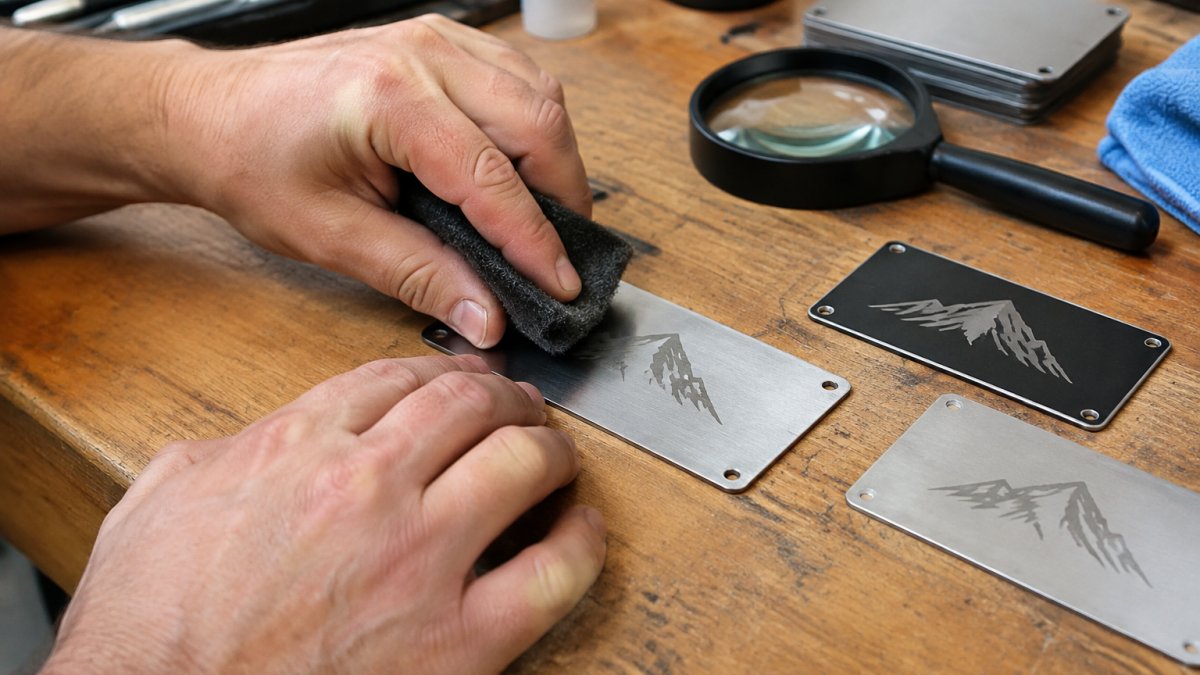
Here is a durability test workflow:
- Rub test: scrub the mark with an abrasive pad for 30 seconds. A surface mark fades; an engraved mark holds.
- Solvent test: wipe with isopropyl alcohol. Ink smears; laser marks do not.
- Scratch test: drag a fingernail or coin across the mark at an angle. Note any flaking on coated stock.
- Heat check: warm the part gently and watch for coating lift around the mark.
- Read test: scan any QR code or data matrix code after each step to confirm it still reads.
Define "permanent" before you test. For most branded merchandise, surviving normal handling and cleaning is enough.
For U.S. manufacturers marking parts for traceability, standards from SAE International on marking and identification and guidance from the National Institute of Standards and Technology are worth checking against your application.
Once your mark passes, upload your STL file for an instant quote through our instant quote system.
Frequently Asked Questions
Does laser engraving wear off aluminum?
A true engraved mark removes or restructures metal, so it does not wear off the way ink or a sticker does. Surface marking on coated or anodized aluminum can be removed if the layer it sits in is abraded away. Bare aluminum marks made with enough power to cut into the surface survive normal handling, cleaning, and outdoor exposure far better than printed labels. The deciding factors are mark type, laser type, and how deep the mark goes.
Can a diode laser engrave bare aluminum?
A standard diode laser usually cannot mark bare aluminum directly because the metal reflects most of the beam's energy. Two workarounds exist: coat the surface with a marking spray or film that absorbs the energy, or use a diode with a higher-power module and very slow scan speeds. Results are shallow and best treated as surface marks. For deep, permanent identification on bare aluminum, a fiber laser is the more reliable tool.
Is laser marking on anodized aluminum permanent?
Anodized aluminum laser engraving is one of the most durable options because the beam alters the anodized layer itself, producing high-contrast white or gray marks without cutting through to bare metal. The mark stays readable through handling and cleaning. It can still be damaged by deep scratches or aggressive abrasion that removes the anodized layer. For nameplates, serial tags, and branded promotional items, this is a dependable choice.
How powerful of a laser do you need to engrave aluminum?
For bare aluminum, a fiber laser in the 20W to 50W range handles most marking and engraving work, with higher power speeding up deep engraving. Diode lasers in the 10W to 40W range can mark coated or sprayed aluminum but struggle with bare metal. CO2 lasers generally cannot mark aluminum at all because the metal reflects their wavelength. Match the laser type to the finish before worrying about wattage.
What affects the durability of a laser mark on aluminum?
Laser power, scan speed, pulse frequency, and how well the beam is focused all change how deep and how dark a mark turns out. The aluminum finish matters just as much: anodized and coated surfaces hold contrast well, while bare aluminum needs enough energy to cut into the metal. Post-processing, such as cleaning residue and adding a protective coating, and the conditions the part faces in service also affect how long the mark stays readable.
Permanence is not a claim you make, it is a property you verify. Test a sample, match your laser to your finish, and choose engraving over surface marking when the mark has to survive. Alex 3D Print Us LLC marks aluminum with MOPA laser engraving, runs multi-color 3D printing for prototypes and branded pieces, and quotes your file instantly so you can confirm results before you commit. Get started with Alex 3D Print Us LLC and put a mark on your parts that outlasts the part.
